書道
shodoThe ancient Japanese art of calligraphy, where brush, ink, and paper unite as a meditative practice that reveals the writer's inner character through every stroke.
Meaning
書道 (しょどう, shodo) literally means "the way of writing" — the character 書 means "writing" and 道 means "way" or "path," the same suffix found in 茶道 (tea ceremony) and 柔道 (judo). More than mere penmanship, shodo is considered a fine art and a spiritual discipline, where each brushstroke is a direct expression of the practitioner's mind, breath, and character.
A well-known saying captures this philosophy perfectly:
書は人なり Sho wa hito nari — "Calligraphy is the person."
The thickness of a line, the speed of a stroke, the pressure and angle of the 筆 (fude, brush) — all of these betray the writer's inner state. A tense mind produces stiff strokes; a calm and focused mind produces fluid, confident ones.
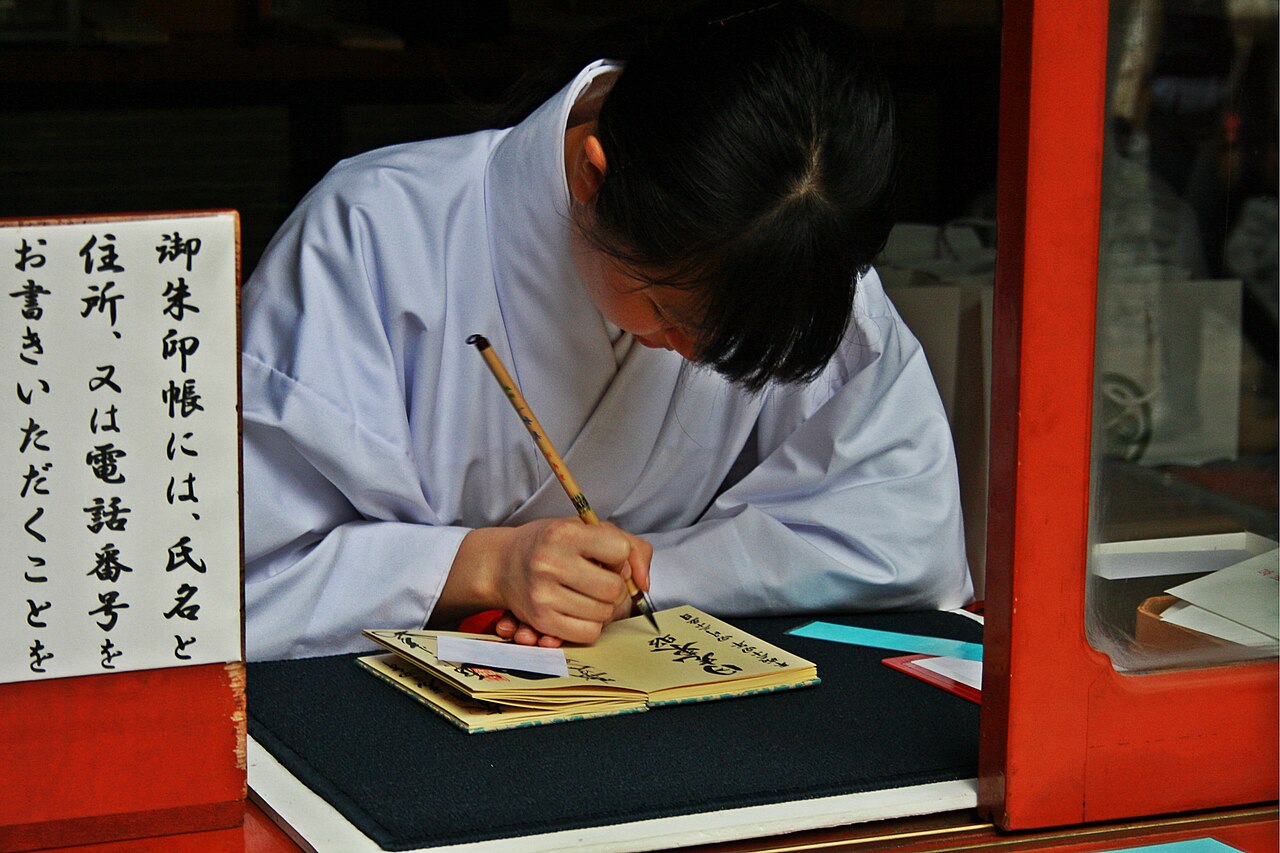
A shrine maiden (miko) practicing shodo at Nikkō Tōshō-gū shrine. Photo: DavideGorla, CC BY 2.0, via Wikimedia Commons.
The Four Treasures
Every calligrapher works with the 文房四宝 (ぶんぼうしほう, bunbō shihō) — the "Four Treasures of the Study." These essential 道具 are:
| Treasure | Japanese | Reading | Description |
|---|---|---|---|
| Brush | 筆 | ふで (fude) | Made from animal hair — wolf, rabbit, sheep — set in a bamboo or wood handle |
| Ink stick | 墨 | すみ (sumi) | Compressed soot and glue, ground against the inkstone |
| Inkstone | 硯 | すずり (suzuri) | A stone dish used to grind and hold the ink |
| Paper | 紙 | かみ (kami) | Traditionally 和紙 (washi), handmade Japanese paper from plant fibres |
Preparing ink by hand — slowly grinding the ink stick against the wet inkstone — is itself part of the meditative ritual. Beginners typically practice on 半紙 (はんし), a thin, absorbent practice paper roughly 25 × 35 cm, which forgives nothing: once the brush touches the surface, the stroke cannot be erased.
The Five Script Styles
Shodo encompasses five major writing styles, each with its own history, aesthetic, and level of difficulty:
楷書 (かいしょ, kaisho) — Regular Script The clearest and most structured style. Every stroke is deliberate and distinct. Children learn kaisho first in school, and it forms the basis of printed Japanese text today. Think of it as the typeset font of traditional calligraphy.
行書 (ぎょうしょ, gyosho) — Semi-cursive Script A flowing compromise between kaisho and sosho. Strokes begin to connect and simplify while remaining largely legible. The name means "traveling writing" — the brush moves forward without stopping.
草書 (そうしょ, sosho) — Cursive Script High-speed, heavily abbreviated strokes that can be nearly unreadable to the untrained eye. Characters are drastically simplified, with multiple strokes merged into single sweeping movements. Sosho is often considered the most artistic and expressive style.
隷書 (れいしょ, reisho) — Clerical Script An older Chinese-derived style with flat, horizontal strokes and distinctive "silkworm head, wild goose tail" endings. Used historically for official documents, it has a dignified, archaic quality.
篆書 (てんしょ, tensho) — Seal Script The oldest style, originally carved into bronze vessels and oracle bones in ancient China. Rounded, symmetrical strokes give it an almost geometric appearance. Today it appears mainly on personal seals (hanko) and formal artwork.
Most practitioners spend years mastering kaisho before attempting gyosho, and decades before tackling sosho.
Cultural Context
Calligraphy entered Japan from China between the 5th and 6th centuries, carried primarily by Buddhist monks who copied sutras as a form of devotional practice. Prince Shōtoku Taishi (574–622) famously encouraged the transcription of sacred texts, cementing the connection between calligraphy and spiritual cultivation.
During the Heian period (794–1185), Japanese courtiers adapted Chinese calligraphy to suit the native kana syllabary, developing a distinctively graceful style known as wayō (和様) — "Japanese style." The flowing aesthetic of Heian kana calligraphy influenced the later development of hiragana as a writing system.
Zen Buddhism deepened shodo's meditative dimension. In Zen temples, 瞑想 (meiso, meditation) and calligraphy were taught side by side, sharing the same goals: single-pointed focus, presence in the moment, and the dissolution of self-consciousness. The 禅 concept of mushin (無心, "no-mind" or "empty mind") — acting without conscious deliberation — is considered the ideal mental state for calligraphy.
Some of Japan's most celebrated historical calligraphers are known as the "Three Brushes" (三筆, sanpitsu): Emperor Saga, Kūkai (the Buddhist monk who founded Shingon Buddhism), and Tachibana no Hayanari, all active in the early Heian period. Their 作品 are national treasures.
Shodo in Education
Unlike in most countries, calligraphy is a compulsory subject in Japanese elementary and middle schools. Students spend hours each week practicing the correct order, angle, and pressure of each stroke, using 習字 (しゅうじ, shuji) — the more basic term for penmanship practice — before advancing toward shodo as a true art form.
The school subject is called shodō at higher levels and serves a dual purpose: developing handwriting skill and instilling patience, discipline, and aesthetic sensitivity. Competitions are held nationally, and prized student 作品 are displayed at school festivals (文化祭, bunkasai).
Modern Revival and Contemporary Shodo
Far from fading in the digital age, shodo has seen a creative revival. Contemporary 書家 (shoか, calligraphers) combine traditional technique with modern composition, large-scale installations, and even live performance calligraphy — writing on stage before an audience as a kind of visual music.
Social media has brought shodo to global audiences. Videos of masters executing a character in a single, unhesitating stroke regularly go viral, drawing millions of viewers who may never have held a brush. Internationally, shodo workshops are now offered at Japanese cultural centres, shrines, and even hotels catering to tourists.
Shodo also intersects with other traditional arts. The same principles of presence and brushwork appear in sado (tea ceremony), ikebana (flower arranging), and painting — all sharing the Zen-influenced ideal of finding beauty in impermanence and imperfection, an aesthetic central to wabi-sabi.
Where to Experience Shodo
- Temple workshops: Zen temples such as Ryōan-ji (Kyoto) and Engaku-ji (Kamakura) occasionally offer calligraphy sessions alongside zazen meditation.
- Cultural centres: The Japan Foundation and prefectural cultural halls run introductory shodo classes in most major cities.
- Tourist experiences: Many ryokan (traditional inns) and heritage sites like Nikkō offer brief hands-on sessions, providing ink, brush, and guidance.
- Specialty shops (文房具店): Calligraphy supply shops in districts like Jimbocho (Tokyo) stock high-quality brushes, inkstones, and washi for those who wish to continue at home.
For visitors to Japan, even a single shodo session offers a window into a discipline that has shaped Japanese aesthetics, education, and spiritual life for over a millennium.
Related Dictionary Words
calligraphy (esp. Asian calligraphy based on Chinese characters)
writing brush; paintbrush; pen
sumi; India ink; Chinese ink; ink stick; ink-cake
inkstone
the four tools of writing (brush, ink, inkstone and paper)
printed style (of writing Chinese characters); square style; block style; standard style
semi-cursive style (of writing Chinese characters); running style
highly cursive style (of writing Chinese characters); grass style
penmanship; calligraphy
calligrapher; individual with good penmanship