寿司
sushiA dish built around vinegared rice, from its fermented-fish origins through Edo-period nigiri to modern conveyor-belt restaurants.
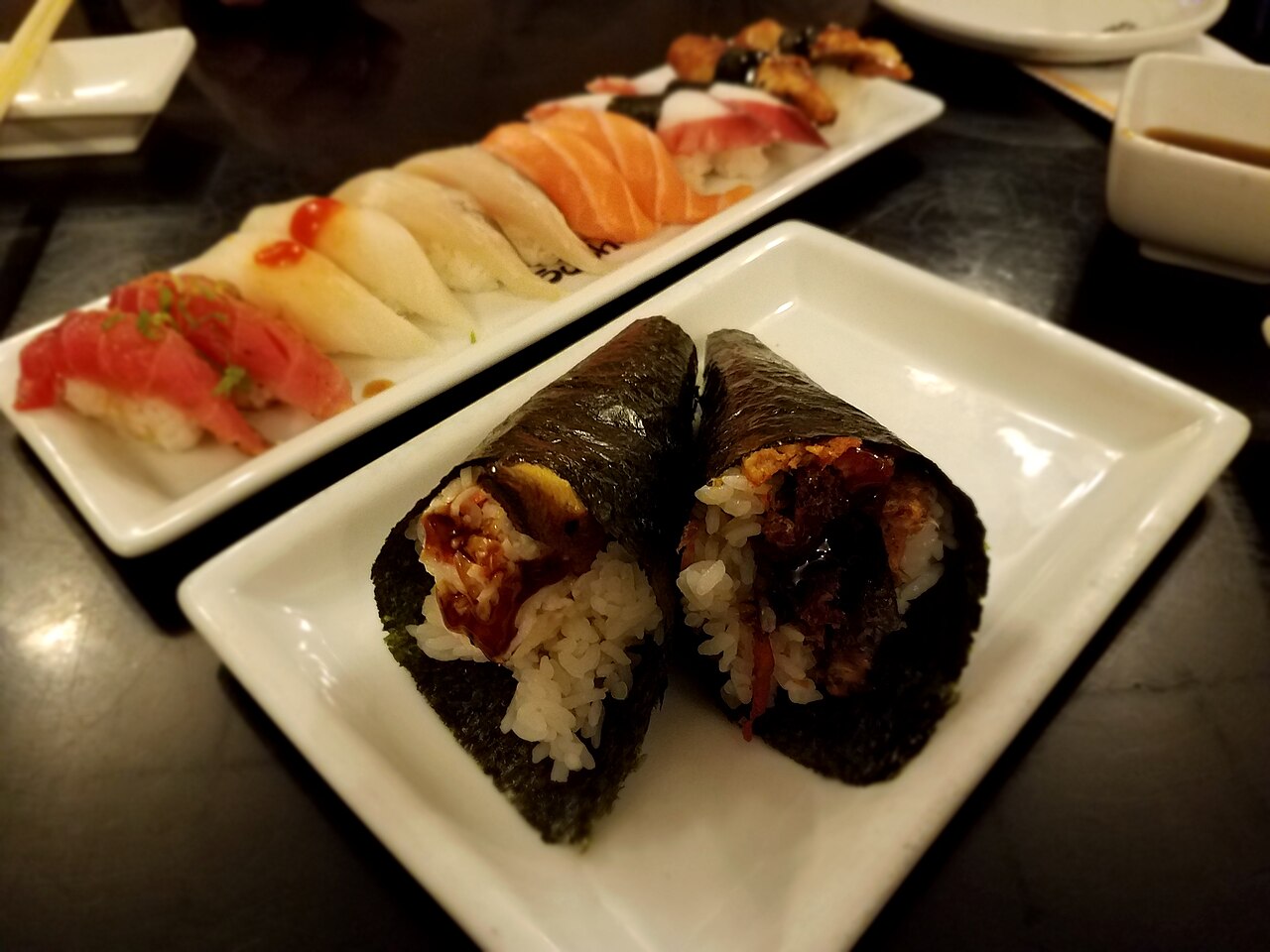
Nigiri-zushi and hand rolls, the two most familiar forms of modern sushi. Photo: RightCowLeftCoast, CC BY-SA 4.0, via Wikimedia Commons.
Meaning
寿司 (すし, sushi) refers not to raw fish, but to vinegared rice — 酢飯 (sushi-meshi or shari), rice seasoned with rice vinegar, sugar, and salt. Almost any dish built around that seasoned rice counts as sushi, whether it's topped with raw 魚, rolled in 海苔 seaweed, wrapped around vegetables, or even served without fish at all. The word can be written with several kanji — 寿司 (a phonetic, celebratory-sounding spelling using characters for "longevity" and "an office/administer"), 鮨, and 鮓 — the latter two pointing back to the dish's origin as a method of preserving fish, not simply eating it fresh.
This is the single most common misconception about sushi: 刺身 (sashimi) is not sushi. Sashimi is sliced raw fish or seafood served on its own, with no rice at all. Sushi is defined by the rice; sashimi is defined by the absence of it. A nigiri topped with raw tuna is sushi because of the rice underneath — remove the rice and slice the same fish onto a plate by itself, and it becomes sashimi instead.
Main Types of Sushi
| Type | Japanese | Description |
|---|---|---|
| Nigiri | 握り(にぎり) | Hand-pressed oblong of rice topped with a slice of fish, shellfish, or 卵 omelette |
| Maki | 巻き寿司(まきずし) | Rice and fillings rolled in nori using a bamboo mat, then sliced into rounds |
| Gunkan-maki | 軍艦巻き(ぐんかんまき) | A nori collar wrapped around rice to hold loose toppings like roe or minced ingredients |
| Temaki | 手巻き(てまき) | A cone-shaped hand roll, eaten immediately before the nori softens |
| Chirashi | ちらし寿司 | A bowl of sushi rice scattered (chirasu, "to scatter") with assorted toppings |
| Inari | 稲荷寿司(いなりずし) | Sushi rice stuffed into a pouch of sweet fried tofu |
| Oshi-zushi | 押し寿司(おしずし) | Rice and fish pressed into a mold, a style associated with the Kansai region |
Nigiri is generally treated as the pinnacle of the craft, since there is nowhere for a chef to hide a mistake: only rice, fish, and a touch of わさび (wasabi).
Edomae-zushi: From Fermented Fish to Edo Fast Food
Sushi's roots are far older, and far less glamorous, than the pristine nigiri counters of today. In the Nara period, nare-zushi (熟れ鮨) was a preservation technique borrowed from Southeast Asia: gutted fish was packed in salted rice and left to ferment for months or even years. The sour, pungent rice was originally discarded — only the preserved fish was eaten. Over centuries this slowly evolved into namanare (半熟れ), a lightly fermented version eaten together with its rice, and eventually into haya-zushi ("fast sushi"), which used vinegar to mimic the sourness of fermentation without the long wait.
The dish familiar today took shape in 江戸時代 (the Edo period, 1603–1868), in the city of Edo — present-day Tokyo. Around the 1820s, a chef named Hanaya Yohei is widely credited with popularizing nigiri-zushi: pressing vinegared rice by hand and topping it with a slice of fresh fish, ready to eat in seconds. Sold from 屋台 street stalls to workers and theatergoers, it was the era's equivalent of fast food — no fermentation, no long wait, just a quick and inexpensive bite.
This style became known as 江戸前 (Edomae), literally "in front of Edo," referring to fish caught in Edo Bay (today's Tokyo Bay) right where the city stood. Edomae-zushi traditionally involves techniques for handling that catch before it ever reaches the counter — curing, salting, marinating in soy sauce, or lightly vinegaring different fish according to what best complements each one, rather than simply serving everything raw. Modern high-end sushi restaurants that describe themselves as Edomae are invoking this specific lineage of craft, not just the general idea of "sushi." The same Edo period produced much of the woodblock print culture the site covers elsewhere — see the ukiyo-e and Hokusai articles for the visual arts that flourished alongside Edo's street food.
Sushi Etiquette
Formal sushi-ya (寿司屋) dining carries its own quiet code of manners, much of it built around not wasting the 職人's (craftsman's) work:
- Eating with hands is fine, even at upscale counters — nigiri was originally hand food. Chopsticks are equally acceptable.
- Dip the fish side, not the rice, in 醤油 soy sauce. Soaking the rice causes it to fall apart and overwhelms the fish's flavor.
- Eat nigiri in one bite. It's shaped and sized specifically for that.
- Don't mix wasabi into your soy sauce dish. A traditional Edomae chef already brushes the correct amount of wasabi between the rice and fish; adding more (or dissolving a puddle of it in soy sauce) is considered an insult to that judgment.
- Gari (pickled ginger) is a palate cleanser, eaten between different pieces of sushi to reset the tongue — not eaten together with a bite of nigiri, and not piled onto it.
- A shared plate of soy sauce is common in casual settings, so use it modestly and avoid contaminating it with rice.
- Order roughly light to rich, working from delicate white fish toward fattier cuts like 鮪 tuna, so stronger flavors don't mask subtler ones — though this rule is followed more strictly at formal counters than casual restaurants.
Kaiten-zushi: Sushi on a Conveyor Belt
Not all sushi comes from a hushed, expensive counter. 回転寿司 (kaiten-zushi, "rotating sushi") — known abroad as conveyor-belt or "running" sushi — is the dish's mass-market, casual counterpart. It was invented in 1958 by restaurateur Yoshiaki Shiraishi in Osaka, who reportedly adapted the idea from watching beer bottles move along a brewery conveyor belt. Plates of nigiri and maki circulate past seated diners on a belt, priced by plate color, letting customers grab whatever looks good without waiting on a chef or ordering by name.
Kaiten-zushi chains transformed sushi from a special-occasion, apprenticeship-driven craft into affordable, everyday food, and the format is now a major driver of sushi's popularity worldwide. Contemporary chains have pushed the concept further with touch-panel tablet ordering, dishes delivered by small express lanes shaped like Shinkansen bullet trains, and QR-code bill tracking — a deliberately different experience from the formality of an Edomae counter, but tracing back to the same dish.
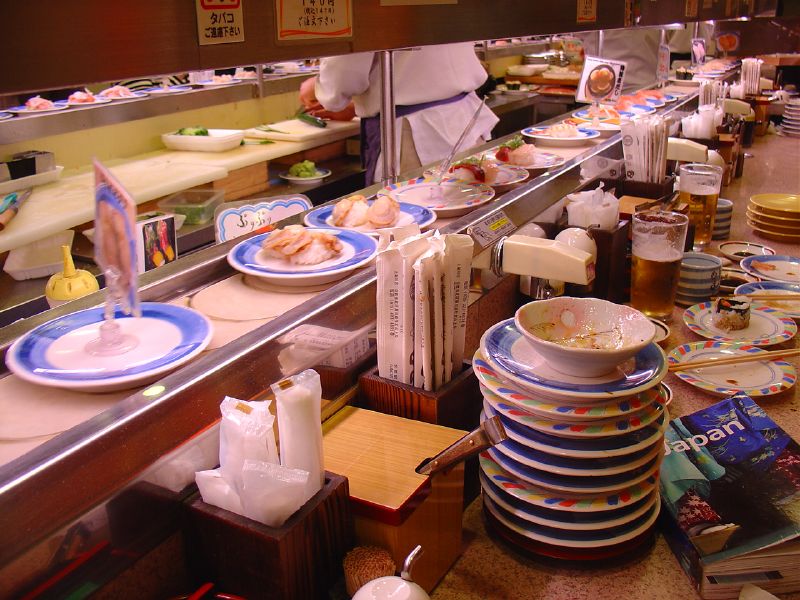
A kaiten-zushi (conveyor-belt sushi) restaurant, where plates circulate past diners for self-service ordering. Photo: EverJean, CC BY 2.0, via Wikimedia Commons.
Sushi Beyond Japan
Raw fish and vinegared rice initially struck many Western diners as an unusual combination, and sushi spread abroad gradually through the 20th century, accelerating after Japanese chefs began adapting it for local tastes — most famously the California roll, an inside-out maki roll built around avocado and crab that hid the nori (and any raw fish) inside the rice. That kind of localization helped sushi become one of the most globally recognized symbols of Japanese cuisine, alongside dishes like ramen and the broader tradition of washoku (traditional Japanese cuisine), which UNESCO added to its Intangible Cultural Heritage list in 2013.
Today sushi exists on a spectrum from ultra-formal omakase counters where a single meal can cost hundreds of dollars, to supermarket takeout trays, to 回転寿司 chains serving dozens of countries — all descended from a method that began as a way to keep fish edible for a few extra months.
Related Dictionary Words
sushi; range of dishes made with vinegared rice combined with fish, vegetables, egg, etc.
grasping; gripping; grasp; grip; clutch
sashimi (raw sliced fish, shellfish or crustaceans)
makizushi; rolled sushi; sushi roll; vinegared rice and fillings rolled in nori or a thin omelette
Tokyo style
conveyor belt sushi; sushi-go-round; sushi train; kaiten-zushi
vinegared rice; rice prepared for sushi
craftsman; artisan; tradesman; worker; workman