和紙
washiTraditional Japanese handmade paper crafted from mulberry and other plant fibers, prized for its strength, texture, and use in everything from shoji screens to art restoration.
Meaning
和紙 (washi) literally means "Japanese paper" — 和 (wa, "Japanese") + 紙 (shi, "paper") — and refers specifically to paper handmade using traditional techniques passed down over more than a thousand years. It is distinct from Western-style wood-pulp paper (洋紙, yōshi) in both material and method: washi is made from long plant fibers rather than short wood-pulp fibers, which gives it exceptional strength, translucency, and longevity. Some washi sheets have survived in temple archives for over a thousand years without significant deterioration.
Manufacturing Process
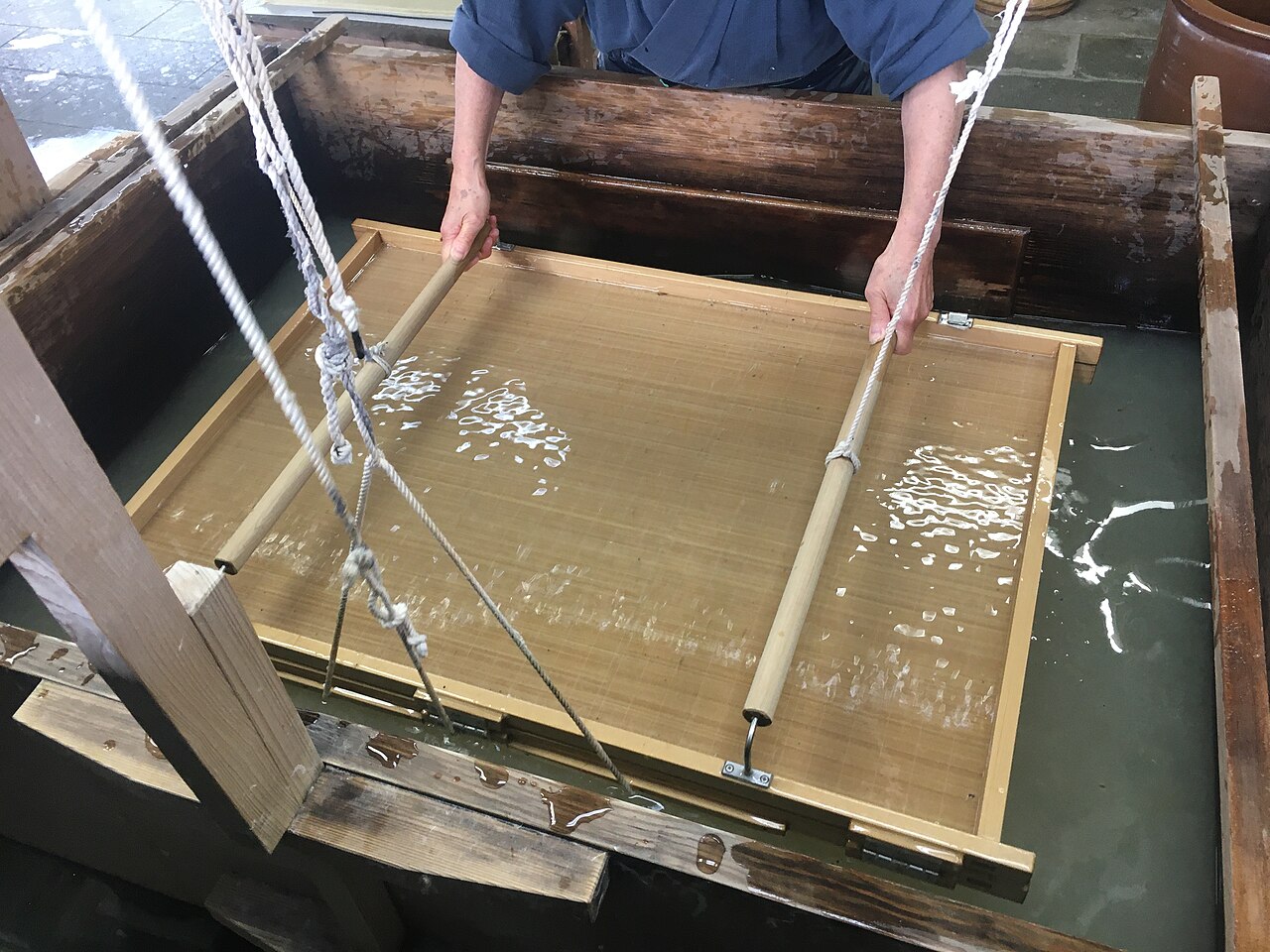
A papermaker performs nagashizuki, rocking a bamboo screen (su) back and forth in a vat of fiber suspension to build up layers of a single sheet. Photo: UFshio, CC BY-SA 4.0, via Wikimedia Commons.
Washi is made almost entirely from the inner bark fibers of three shrubs:
- 楮 (kōzo) — paper mulberry, the most common fiber, valued for its long, strong fibers that produce tough, durable paper used for shoji screens and calligraphy practice sheets.
- 三椏 (mitsumata) — a shrub with softer, finer fibers that yield smooth, slightly glossy paper traditionally used for banknotes and high-grade stationery.
- 雁皮 (gampi) — a wild shrub that cannot be cultivated on plantations, producing the finest, most lustrous paper, historically reserved for important documents and export goods.
The traditional process runs through several stages: harvested branches are steamed to loosen the bark, which is stripped and the outer black bark scraped away to leave the usable inner white bast fiber (kōzo no shiroi kawa). The fibers are then boiled with wood ash or soda ash to soften them, beaten by hand or machine into a pulp, and mixed with water and a mucilage extracted from the tororo-aoi (hibiscus) root, which keeps the fibers evenly suspended.
The defining step is nagashizuki (流し漉き, "pouring/flow forming"), a sheet-forming technique unique to Japan. The craftsperson scoops the fiber suspension onto a 手漉き (tesuki, hand-forming) screen made of thin bamboo strips (su) mounted in a wooden frame (keta), then rocks it back and forth and side to side, letting excess water drain through while layering fibers in overlapping directions. This repeated motion — unlike the single-pour method used for Western handmade paper — interlocks the long fibers into a dense, felted mat, which is what gives washi its remarkable strength relative to its thinness. The wet sheets are stacked, pressed to remove water, then peeled apart and dried individually, traditionally on wooden boards or steel plates in the open air.
Historical Significance
Papermaking technique reached Japan from China via Korea in the early 7th century, and Japanese craftspeople adapted and refined it into the distinct nagashizuki method by the Heian period (794–1185). Washi quickly became central to Japanese civilization: it was the medium for Buddhist sutras, government records, and later the writing surface for waka poetry and 書道 (shodō, calligraphy). Because of its strength and flexibility, washi was also engineered into structural and everyday materials — sliding 障子 screens, umbrellas, fans, lanterns, and even reinforced armor and clothing (kamiko).
During the Edo period (1603–1868), regional papermaking villages flourished under feudal patronage, each developing specialized techniques and grades of paper for different uses, from official documents to woodblock-print paper for 浮世絵 (ukiyo-e). Industrialization in the Meiji era brought cheaper Western wood-pulp paper, and washi production declined sharply through the 20th century as everyday paper needs shifted to mass-produced alternatives. What remained became increasingly defined as a craft and art form rather than a commodity.
Regional Varieties and UNESCO Recognition
Japan once had thousands of local washi-producing villages; today a much smaller number of workshops keep the craft alive, each associated with a distinct regional style:
| Variety | Region | Known for |
|---|---|---|
| 美濃和紙 (Mino washi) | Gifu Prefecture | Thin, even, translucent sheets prized for shoji and lampshades; over 1,300 years of continuous production |
| 越前和紙 (Echizen washi) | Fukui Prefecture | Wide range of grades, from ultra-fine calligraphy paper to thick, durable craft paper; associated with the paper deity Kawakami Gozen |
| Hosokawa-shi | Saitama Prefecture | Robust kōzo paper historically used for account books and documents |
| Tosa washi | Kōchi Prefecture | Extremely thin, strong paper used for art restoration and traditional lace-paper (レース和紙) |
In 2014, UNESCO inscribed "Washi, craftsmanship of traditional Japanese hand-made paper" on the Representative List of the Intangible Cultural Heritage of Humanity, covering three specific traditions: Sekishu-banshi (Shimane Prefecture), Hon-mino-shi (the Mino tradition, Gifu Prefecture), and Hosokawa-shi (Saitama Prefecture). The listing recognizes not just the finished paper but the whole chain of knowledge — cultivating kōzo, harvesting and processing fiber, and practicing nagashizuki — as a living cultural practice at risk of disappearing without active transmission to new generations of artisans (職人, shokunin).
Uses Today
Washi's combination of strength, texture, and translucency keeps it in active use well beyond museum shelves:
- Architecture and interiors — 障子 sliding screens and lampshades still rely on washi's soft, diffused light transmission.
- Calligraphy and painting — 書道 practice paper and traditional ink-wash painting surfaces are almost always washi, since it absorbs ink differently from wood-pulp paper.
- 折り紙 (origami) — washi's fiber strength lets it hold sharp, crisp folds without tearing, making it the traditional paper of choice for fine origami work.
- Art and book restoration — because of its purity, acid-free composition, and long fiber length, thin kōzo-based washi (often called "Japanese tissue" in English-language conservation literature) is the international standard material for repairing torn manuscripts, prints, and paintings in museums and archives worldwide.
- Fashion and design — contemporary designers use washi-based textiles (shifu, woven from thread spun out of paper strips) and washi-laminated products in clothing, wallets, and interior goods, part of a broader revival of traditional crafts in modern design.
- Fine stationery and gifts — decorative washi with embedded flowers, dyes, or metallic leaf is widely sold for greeting cards, gift wrapping, and stationery both in Japan and internationally.
Related Terms
- 手漉き和紙 (tesuki washi) — "hand-formed washi," distinguishing fully hand-made sheets from machine-made imitation washi (機械漉き, kikai-zuki).
- 障子紙 (shōji-gami) — washi specifically manufactured for shoji screens.
- 千代紙 (chiyogami) — brightly patterned washi used for origami and crafts, distinct from plain writing washi.
Washi's story mirrors that of many Japanese crafts: a once-universal material displaced by industrial substitutes, now sustained by a smaller circle of dedicated artisans and recognized internationally as an irreplaceable cultural technology.
Related Dictionary Words
washi; Japanese paper
kozo (Broussonetia kazinoki x papyrifera); Japanese paper mulberry tree
Oriental paper bush (Edgeworthia chrysantha); mitsumata
Diplomorpha sikokiana (species of flowering plant)
hand paper-making; handmade paper
paper
calligraphy (esp. Asian calligraphy based on Chinese characters)
origami; art of paper folding
shoji (paper sliding door)
Mino (former province located in the south of present-day Gifu Prefecture)
Echizen (former province located in parts of present-day Fukui and Gifu prefectures)
craftsman; artisan; tradesman; worker; workman
tradition; convention
fibre; fiber
restoration; repair; mending