墨絵
sumi-eTraditional Japanese monochrome ink wash painting that captures the essence of a subject with a few confident brushstrokes rather than photorealistic detail.
Meaning
墨絵 (sumi-e), more formally called 水墨画 (suibokuga), is Japanese ink wash painting done entirely in black 墨 (sumi) ink, diluted to a range of tones from deep black to the palest grey. Instead of building up a picture layer by layer, a sumi-e painter tries to capture a subject in as few brushstrokes as possible — a single loaded stroke of the brush might render an entire bamboo leaf, a bird's wing, or the curve of a mountain ridge.
The word itself is simple: 墨 means "ink" and 絵 means "picture," so 墨絵 literally means "ink picture." 水墨画 adds 水 (water) and 画 (painting), describing the same art form more formally as "ink-and-water painting."
What distinguishes sumi-e from Western drawing or even from full-color Japanese painting styles is its relationship to emptiness. Unpainted paper is not treated as background to be filled in — it is an active compositional element called 余白 (yohaku), "white space," closely related to the broader aesthetic concept of ma (間), meaningful negative space. A few strokes of a pine branch floating in an otherwise blank field of paper can suggest mist, distance, or open sky far more powerfully than if every inch were rendered.
Technique and the Four Treasures
Sumi-e is built around four traditional tools, sometimes called the "Four Treasures of the Study" (文房四宝):
| Tool | Japanese | Role |
|---|---|---|
| Brush | 筆 (fude) | A soft animal-hair brush that holds a large reservoir of ink and can produce a thick or thin line, wet or dry, in a single stroke |
| Ink | 墨 (sumi) | A solid stick of soot and animal glue, ground fresh before use |
| Inkstone | 硯 (suzuri) | A stone slab on which the inkstick is ground with water into liquid ink |
| Paper | 紙 (washi) or silk | Absorbent paper that immediately soaks up ink, recording every hesitation or confidence in the brush's movement |
The painter grinds the inkstick against the inkstone with a little water, working up a pool of ink whose thickness can be adjusted from moment to moment. Because washi paper absorbs ink instantly and does not allow corrections, every stroke is final — a wash of very wet, dilute ink bleeds and blooms across the fibers, while a nearly dry brush dragged quickly across the surface leaves a broken, textured line (a technique called kasure, "scratchiness"). This combination of an unforgiving surface and a single loaded brush is why sumi-e demands enormous control and, more importantly, decisiveness: the painting exists in the mind before the brush ever touches the paper.
A related technique, 破墨 (haboku, "broken ink") or its wetter cousin 溌墨 (hatsuboku, "splashed ink"), abandons careful outlines altogether. Ink is dropped or splashed onto the paper in loose, almost accidental-looking pools, and a mountain or a hut only resolves itself as the eye steps back — an extreme expression of suggesting form rather than describing it.
Philosophy: essence over detail
Sumi-e is less concerned with faithfully copying what the eye sees than with conveying the inner character, or spirit, of the subject — a concept close to the older Chinese painting principle of qiyun shengdong (気韻生動, "spirit resonance, life-motion"). A bamboo stalk painted in sumi-e is not a botanical record of bamboo; it is an attempt to capture the plant's resilience and flexibility in the rhythm of the brushwork itself.
This philosophy is inseparable from 禅 (Zen) Buddhism, which shaped sumi-e from its earliest days in Japan. Zen training emphasizes direct, unmediated insight arrived at through disciplined practice rather than intellectual analysis, and sumi-e painting became a kind of meditative practice for Zen monks — the brush stroke as an act of presence, executed once, without revision. The 円相 (ensō), a single circular brushstroke often left slightly open, is the clearest expression of this idea: painted in one breath, it is said to reveal the state of mind of the painter at that exact moment, and no two are ever the same.
This same sensibility connects sumi-e to the broader aesthetic of 侘び寂び (wabi-sabi) — beauty found in imperfection, transience, and restraint — and to the tea ceremony (茶道, sadō), where a sumi-e scroll or an ensō is often hung in the tokonoma alcove to set the tone for a gathering. Sumi-e is sometimes confused with 書道 (shodō), Japanese calligraphy, since both use the same ink, brush, and paper and share this Zen-influenced aesthetic of the single, unrepeatable stroke — but shodō renders written characters, while sumi-e renders images of the visible world.
History
Ink wash painting originated in China, where it had already been refined for centuries by the time it reached Japan. It was carried across the sea largely by Zen Buddhist monks who traveled to China to study during the Kamakura period (1185-1333) and brought the technique back along with Zen teachings, sutras, and other continental culture. Early Japanese practitioners, monks themselves, painted mostly religious and philosophical subjects — Zen patriarchs, Bodhidharma, mountain hermitages — in a style still closely following Chinese Song and Yuan dynasty models.
Sumi-e matured into a distinctly Japanese art form during the Muromachi period (1336-1573), and its most celebrated master is the Zen monk-painter Sesshū Tōyō (雪舟, 1420-1506). Sesshū traveled to Ming-dynasty China himself, but rather than simply imitating Chinese landscape conventions, he developed a bolder, more spontaneous, and distinctly Japanese approach to line and composition, becoming the figure most credited with "Japanizing" ink painting. His scroll Haboku Sansui (破墨山水図, "Splashed Ink Landscape"), painted in 1495, is considered a masterpiece of the haboku technique and remains one of the most reproduced works in Japanese art history.
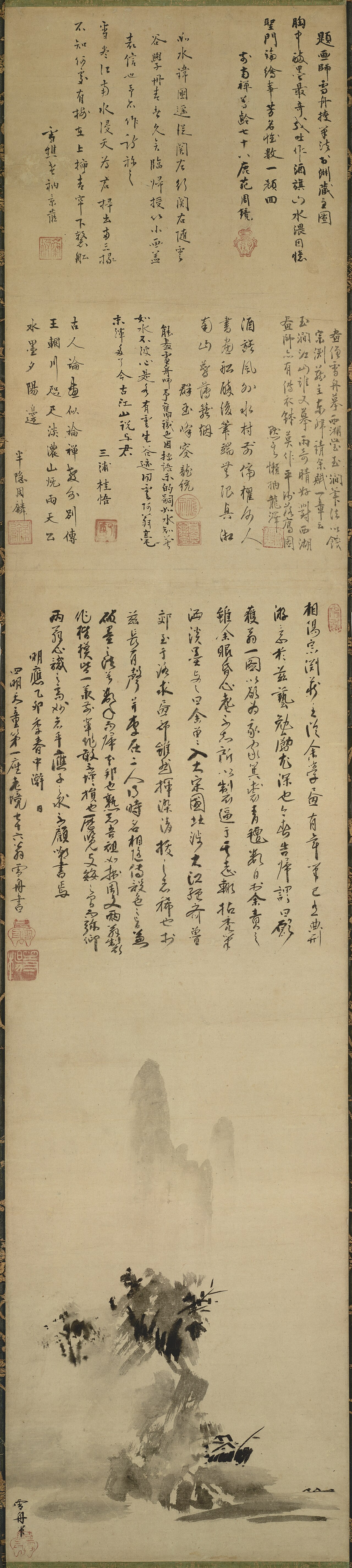
Haboku-Sansui (破墨山水図), Sesshū Tōyō, 1495. A mountain hut and pines dissolve into pools of splashed and broken ink. Public domain, via Wikimedia Commons.
After Sesshū, later schools such as the Kanō school absorbed ink painting techniques and blended them with color and gold-leaf decoration for the grand screens and sliding doors of castles and temples, while independent ink painters kept the monochrome tradition alive in a purer form.
Common subjects
Sumi-e draws on a relatively fixed repertoire of subjects, prized precisely because their simple forms reward mastery of a few essential brush techniques:
- Bamboo (竹, take) — Considered the ideal training subject: a single confident stroke for each segment of stalk, a flick of the wrist for each leaf. Bamboo's resilience under wind is read as a metaphor for character that bends but does not break.
- Landscapes (山水, sansui, literally 'mountain-water') — Misty mountains, waterfalls, and lone travelers or huts, often built from a handful of large ink washes rather than fine detail.
- Birds and flowers (花鳥, kachō) — Plum blossoms, cranes, sparrows, and other seasonal motifs, frequently paired with calligraphic inscriptions on hanging scrolls (掛け軸, kakejiku).
- The Four Gentlemen (四君子) — Plum, orchid, bamboo, and chrysanthemum, the four plants that together represent the four seasons and four virtues in the shared Chinese-Japanese literati painting tradition.
- The Zen circle (円相, ensō) — A single, often incomplete, circular stroke representing enlightenment, the void, or the universe.
Mastery in sumi-e is measured largely by control of 濃淡 (nōtan), the interplay of light and dark ink tones, since color is never available to separate one form from another.
Legacy and modern influence
Sumi-e's disciplined minimalism — doing more with less, trusting empty space, and prizing a single decisive gesture over accumulated detail — echoes throughout later Japanese visual culture. The restrained compositions and asymmetry found in Japanese garden design, in ikebana flower arrangement, and even in the deliberate emptiness of modern graphic and product design all trace an aesthetic lineage back through sumi-e's use of yohaku. The ukiyo-e woodblock print masters of the Edo period, though working in a very different, mass-produced medium, inherited some of the same instinct for economical line and bold composition found in ink painting.
Today sumi-e is practiced both as a living fine-art tradition in Japan and as a popular introductory art form abroad, often taught alongside shodō as an approachable entry point into Japanese brush arts — requiring only ink, a brush, paper, and, ideally, patience.
Related Terms
| Term | Reading | Meaning |
|---|---|---|
| 水墨画 | すいぼくが | Ink wash painting (formal term) |
| 破墨 | はぼく | "Broken ink" — loose, splashed technique |
| 余白 | よはく | Meaningful blank/negative space |
| 濃淡 | のうたん | Gradation of ink tone, light and dark |
| 円相 | えんそう | Zen ink circle |
| 掛け軸 | かけじく | Hanging scroll |
Related Dictionary Words
sumi; India ink; Chinese ink; ink stick; ink-cake
picture; drawing; painting; sketch
India-ink painting
dhyana (profound meditation)
blank space; margin; blank canvas
bamboo (any grass of subfamily Bambusoideae)
writing brush; paintbrush; pen
inkstone
paper
wabi-sabi; aesthetic sense in Japanese art centered on the acceptance of transience and imperfection
circle painted with a single stroke in Zen calligraphy (representing the perfect peace of mind)
calligraphy (esp. Asian calligraphy based on Chinese characters)
tea ceremony; Way of Tea; sadō
mountain and water; landscape (containing hills and rivers)
flowers and birds
light and shade; shade (of colour, color)
being animated (vivid) with grace (elegance, refinement)
hanging scroll