神楽
kaguraKagura is Shinto ritual dance-theater performed to entertain and appease the kami, considered the oldest of Japan's traditional performing arts.
Meaning
神楽 (kagura) is a form of ritual 舞 (dance) performed as an offering to the 神 (kami, Shinto deities). Unlike theater forms meant primarily for a human audience, kagura's original purpose is communication with the divine — the dance is offered so that the gods will draw near, be pleased, and bestow blessings such as good harvests, safety, and purification. The word itself is generally explained as a contraction of kamikura or kamu-kura (神座), meaning "seat of the gods," referring to the sacred space where a deity is invited to descend and reside during the ritual.
Because kagura predates both writing and organized theater in Japan, it is often called the root of all later Japanese performing arts, including 能 (Noh) and 歌舞伎 (Kabuki), both of which absorbed kagura's masked, dance-based storytelling into more theatrical, secular forms centuries later.
Origin Myth
The mythological origin of kagura appears in Japan's oldest chronicles, the Kojiki (712) and Nihon Shoki (720). When the sun goddess 天照大神 (Amaterasu Ōmikami) hid herself inside the Ama-no-Iwato, the heavenly rock cave, the world was plunged into darkness. To lure her out, the goddess Ame-no-Uzume performed a wild, comic, and semi-erotic dance atop an overturned tub, stamping her feet, which caused the assembled gods (kami) to roar with laughter. Amaterasu, curious about the commotion outside her cave, peeked out — and was pulled into the light, restoring the sun to the world.
天鈿女命、天の岩戸の前で舞い踊った。 Ame-no-Uzume-no-Mikoto danced before the heavenly rock cave.
This episode — the 岩戸 (Iwato, "rock cave") myth — is treated as the founding act of kagura, and Ame-no-Uzume is revered as the art's patron deity. Reenactments of the Iwato scene remain one of the most common and beloved programs in kagura repertoires across Japan today.
Mikagura and Satokagura
Kagura branches into two broad traditions that developed along very different institutional paths.
| Mikagura (御神楽) | Satokagura (里神楽) | |
|---|---|---|
| Performed at | The Imperial Court, Tokyo | Local shrines nationwide |
| Audience | Imperial household, court ritual | General public, villagers |
| Style | Formal, restrained, largely unmasked | Varied — masked, narrative, often lively |
| Music | Court gagaku-style instruments | Regional folk instrumentation, often 太鼓 (taiko) and flute |
| Best known for | Mikagura-uta (sacred songs) performed annually at the Imperial Palace | Countless regional styles, e.g. Iwami, Izumo, Takachiho |
Mikagura (御神楽), "court kagura," is the austere, ceremonial form preserved by the Imperial Household Agency and performed at the palace's Naishidokoro (Kashikodokoro) shrine, most notably each December at the Kagura Mi-Kyū rite. It uses a small, fixed set of ancient songs (mikagura-uta), accompanied by wagon (a six-stringed zither), flute, and hichiriki, and its choreography has changed little over the last thousand years. It is rarely open to public viewing.
Satokagura (里神楽), "village" or "regional kagura," is the far larger and more visible category, encompassing thousands of local traditions performed at shrines across the country. Satokagura ranges from quiet, slow miko-mai — dances performed by shrine maidens (巫女, miko) with bells and sacred branches — to the elaborate, masked, story-driven performances found in regions such as Shimane, Hiroshima, and Miyazaki. Satokagura is traditionally grouped into several regional lineages, including Ise-ryū, Izumo-ryū, Shishi-kagura (lion-dance kagura), and Miko-kagura, each with its own repertoire, mask styles, and musical conventions.
Iwami Kagura and Other Regional Traditions
Among the hundreds of local satokagura traditions, Iwami kagura (石見神楽), from the Iwami region of western Shimane Prefecture, is the most famous nationally. It is known for its fast tempo, driving taiko rhythms, and spectacular costumes — most iconically its giant orochi (eight-headed serpent) puppets in the Yamata-no-Orochi program, a dramatization of the storm god Susanoo slaying the monstrous serpent to save a maiden. Unlike the slow, ceremonial mikagura, Iwami kagura is a genuine crowd-pleasing spectacle, performed late into the night at shrine festivals and increasingly staged for tourists in dedicated halls.
Other celebrated regional styles include:
- Takachiho kagura (Miyazaki) — 33 sequential dances performed overnight at village halls each winter, recognized as part of a UNESCO Intangible Cultural Heritage practice.
- Izumo kagura (Shimane) — centered on Izumo Taisha, considered by many scholars the historical wellspring from which Iwami and other western-Japan kagura styles descended.
- Shishi-kagura — lion-dance kagura found across the Tōhoku region, blending kagura with shishimai (lion dance) performance.
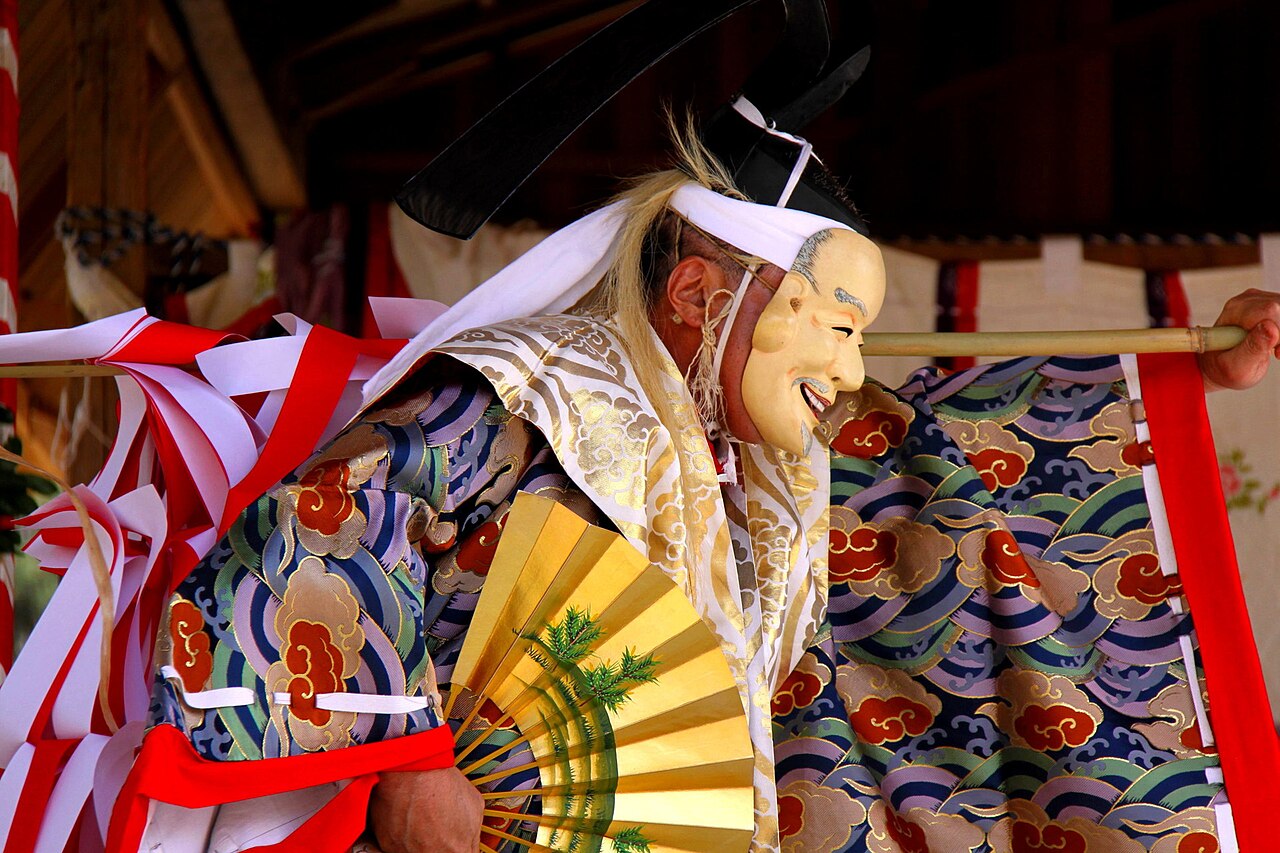
A kagura performance associated with Izumo Taisha, Shimane Prefecture — one of the historic centers of Japan's regional kagura traditions. Photo: iku, CC BY-SA 4.0, via Wikimedia Commons.
Masks, Costumes, and Music
Satokagura performances are often built around a cast of stock characters portrayed with carved wooden or papier-mâché masks (仮面, kamen). Common mask types include fierce serpent and demon (oni) faces for villains, dignified god masks for heroic deities like Susanoo, comic old-man and old-woman masks, and the grinning, red-faced Shoki (鍾馗) mask representing a demon-queller imported from Chinese folklore.
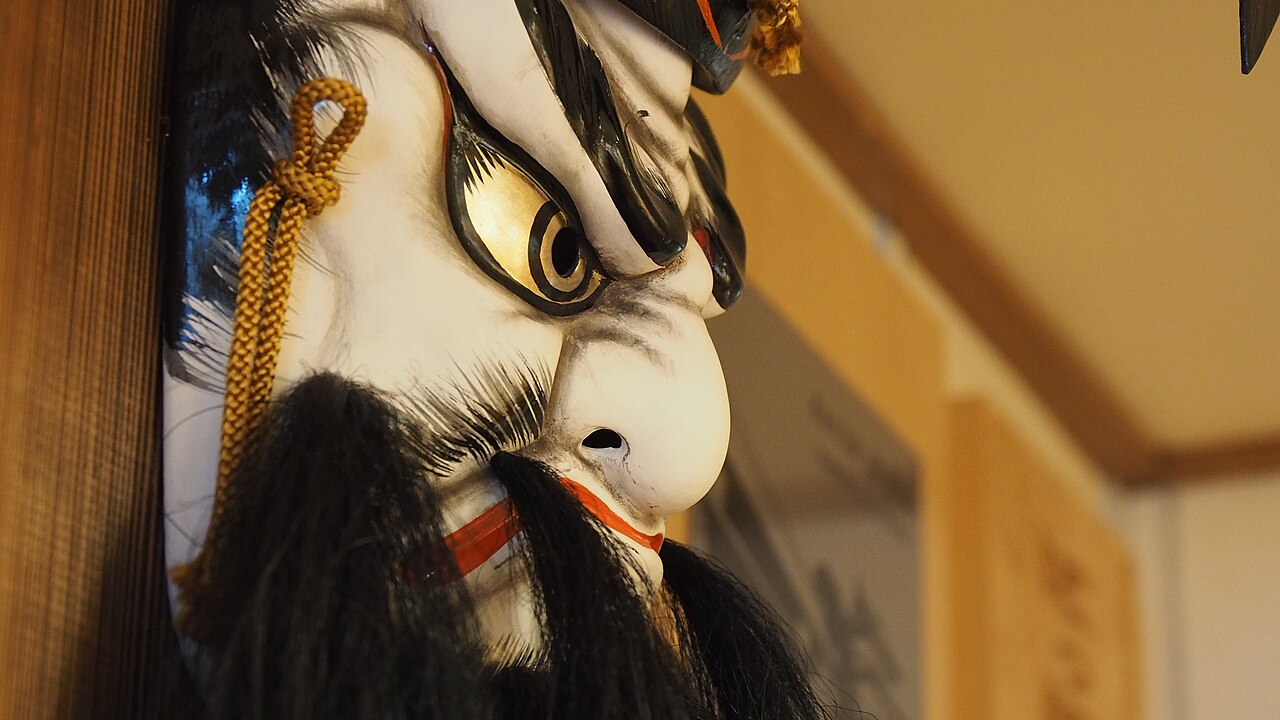
A Shoki (鍾馗) mask used in kagura performances in Shimane Prefecture. Photo: Ka23 13, CC BY-SA 4.0, via Wikimedia Commons.
Costumes are equally elaborate: heavy brocade robes echoing court dress, oversized serpent bodies of painted cloth stretched over bamboo frames for orochi dances, and the plain white robes and red hakama worn by miko performing shrine-maiden kagura. Performers carry ritual implements — a torimono (handheld sacred object) such as bells (鈴, suzu), a fan, a sword, or a sakaki branch — that mark the dance as an offering rather than ordinary theater.
Music is provided by hayashi ensembles of taiko drums, hand cymbals (chappa), and a transverse flute (fue), with tempo and intensity driving the dramatic pacing — Iwami kagura in particular is known for its unusually fast, percussive drumming compared to the slower court style.
Kagura and Matsuri
Kagura is inseparable from the annual cycle of shrine festivals, or 祭り (matsuri). Performances traditionally take place on a shrine's kagura-den (a dedicated stage building) or on a temporary outdoor 舞台 (stage) erected for the festival, often continuing through the night as an offering timed to the shrine's autumn harvest festival or New Year purification rites. In many rural communities, kagura troupes are organized by local preservation societies (hozonkai) that pass choreography, music, and mask-making techniques down through generations, often as one of the community's few remaining living folk-art traditions.
Kagura in Japan Today
While mikagura remains an exclusive Imperial rite, satokagura has grown into both a living folk tradition and a popular tourist draw. Regions famous for kagura — especially Shimane's Iwami district — host regular public performances in dedicated kagura halls and at Izumo Taisha, marketed explicitly to domestic and international visitors as a way to experience "authentic" traditional Japan. Some troupes tour internationally, and several regional kagura traditions, including Takachiho kagura, have been inscribed on UNESCO's Representative List of the Intangible Cultural Heritage of Humanity.
Kagura's imagery — its masks, the Orochi serpent, and the Iwato myth — also continues to influence Japanese popular culture, appearing in festivals, regional mascots, video games, and anime that draw on Shinto mythology. Even so, most satokagura troupes remain small, volunteer-run community organizations facing the same rural depopulation pressures affecting many Japanese folk arts, making festival tourism and cultural heritage designations an important part of their survival today.
Related Terms
- 神楽殿 (kagura-den) — the dedicated shrine stage building where kagura is performed
- 巫女神楽 (miko-kagura) — kagura performed by shrine maidens, often the gentlest, most ceremonial style
- 湯立神楽 (yudate-kagura) — a purification kagura involving boiling water, performed to bless participants
- 神事 (shinji) — Shinto ritual rites in general, of which kagura is one form
Related Dictionary Words
kagura; traditional Shinto music and dancing
miko; shrine maiden; young girl or woman (trad. an unmarried virgin) who assists priests at shrines
festival; feast; matsuri
talent; gift; function
kabuki; traditional form of drama and music performed by male actors wearing makeup mainly in white and red
mask
god; deity; divinity; spirit; kami
dancing; dance
bell (often globular)
drum
Shinto shrine
Amaterasu Ōmikami (sun goddess)
rock door (to a cave)
stage (of a theatre, concert hall, etc.)