歌川国芳
Utagawa KuniyoshiEdo-period ukiyo-e master famed for dynamic warrior prints, ghosts and yokai, biting satire, and his beloved cat-themed woodblock prints.
Meaning
Utagawa Kuniyoshi (歌川国芳, 1798-1861) was one of the last great masters of 浮世絵 ("pictures of the floating world"), the woodblock print tradition that flourished in Edo-period Japan. Alongside his contemporaries Hokusai, Hiroshige, and Utamaro, he ranks among the medium's most inventive artists — but where Hokusai is remembered for landscapes and Hiroshige for travel scenes, Kuniyoshi became famous for sheer imaginative range: heroic 武士 locked in battle, monstrous skeletons and 妖怪, and above all, an enduring obsession with cats.
Kuniyoshi worked in the Utagawa school, the dominant print workshop lineage of the 19th century (the same school that produced Hiroshige and, later, Kuniyoshi's own students, some of whom went on to shape early manga illustration). His output was enormous and stylistically restless — he moved fluidly between blood-and-thunder warrior prints, tender depictions of everyday life, biting political satire, and prints so playful they verge on outright comedy.
Life and Career
Born in 1798 to a dyer in Edo (modern Tokyo), Kuniyoshi apprenticed under Utagawa Toyokuni, the leading print master of the day, entering the trade alongside a young Utagawa Kunisada. His early career stalled — for years he struggled in Kunisada's shadow, producing unremarkable book illustrations. His breakthrough came in 1827 with a series illustrating the Suikoden (水滸伝), a classic Chinese tale of 108 outlaw-heroes, translated into Japanese as Tsūzoku Suikoden Gōketsu Hyakuhachinin no Hitori ("One of the 108 Heroes of the Popular Suikoden"). The prints, dense with muscular tattooed warriors in dynamic combat poses, were an immediate sensation and single-handedly launched a fashion for decorative tattoos among Edo's firemen and laborers who wanted to look like Kuniyoshi's heroes.
From that point Kuniyoshi worked continuously until his death in 1861, producing an estimated several thousand individual print designs across warrior epics, historical legend, kabuki actor portraits, landscapes, and comic subjects. He was known as a colorful, somewhat eccentric figure — a devoted cat lover who reportedly kept numerous cats in his studio and even worked with one tucked inside his kimono — and he trained a large workshop of students, several of whom carried his style into the Meiji era.
Signature Style and Subject Matter
Warriors and the Suikoden
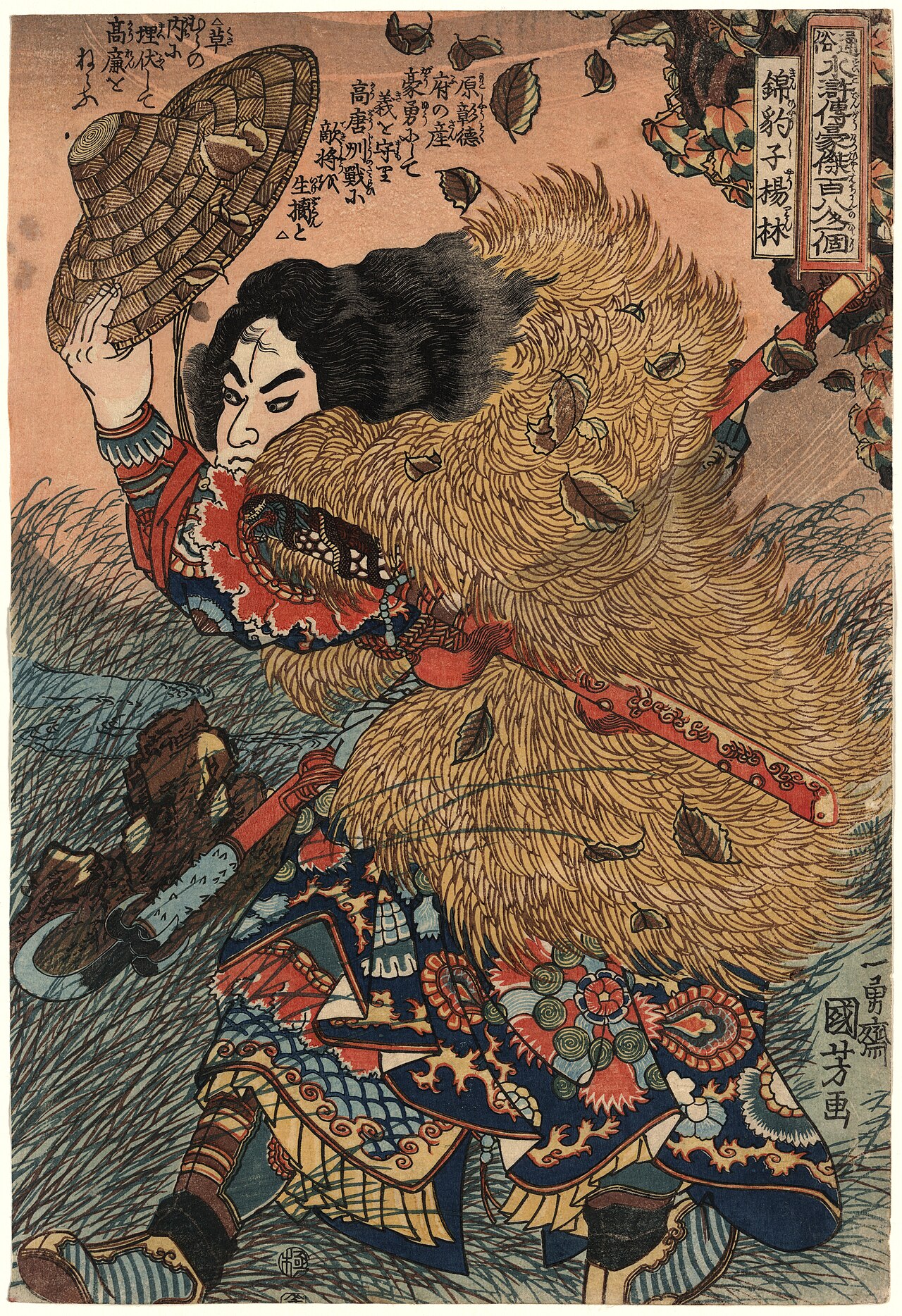
A Kuniyoshi print from his 108 Heroes of the Suikoden series, showing his trademark twisting, muscular combat poses. Public domain, via Wikimedia Commons.
Kuniyoshi's 108 Heroes of the Suikoden remains his most historically significant series. Each print isolates a single hero in a moment of explosive action — leaping through water, wrestling a giant snake, or brandishing a blade mid-swing — rendered with anatomical exaggeration, bold diagonal compositions, and the swirling tattoo patterns that made the series iconic. The dynamism of these compositions, favoring extreme poses and dramatic cropping over static portraiture, is often cited by manga and anime historians as an early ancestor of the exaggerated action linework seen in modern Japanese comics.
Cats
Kuniyoshi's cat prints are, for many modern audiences, his most beloved and instantly recognizable work. He drew cats obsessively and in every register: as sly commentary, as pure whimsy, and as outright substitutes for human subjects.
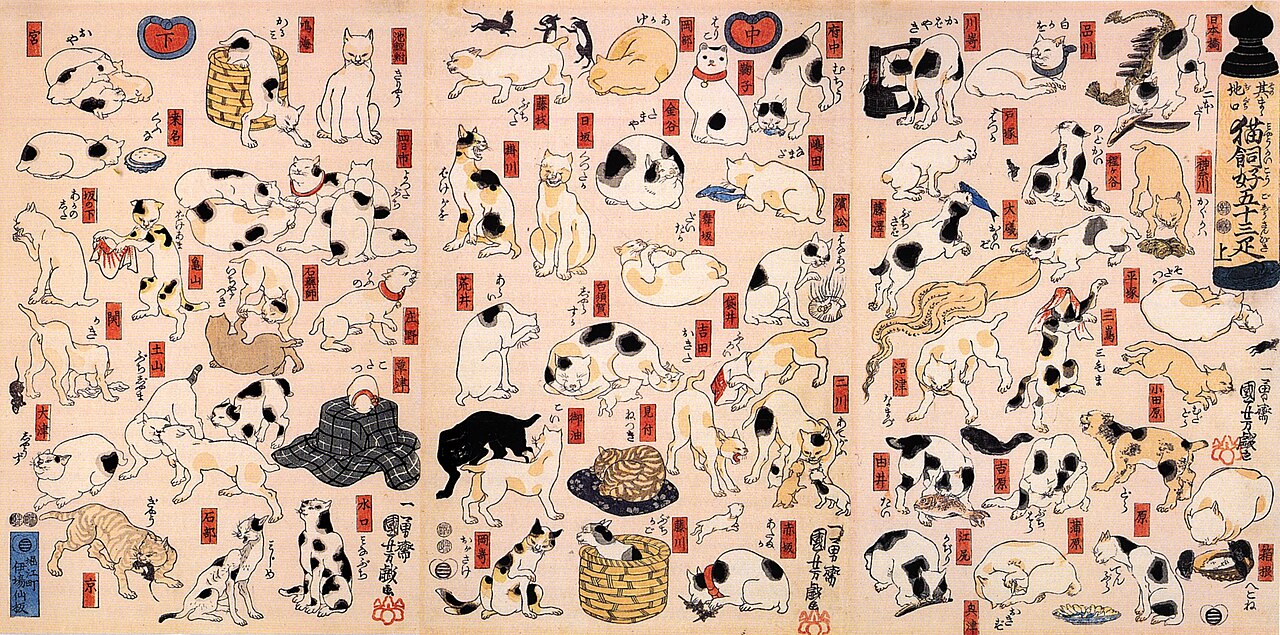
"Cats Suggested as the Fifty-three Stations of the Tokaido" (1850), Kuniyoshi's famous print built entirely from puns pairing cat poses and props with Tokaido station names. Public domain, via Wikimedia Commons.
His best-known work in this vein, Cats Suggested as the Fifty-three Stations of the Tokaido (猫の当字 東海道五十三次, 1850), reimagines Hiroshige's famous travel-print series — itself depicting the 53 post stations along the Tokaido highway between Edo and Kyoto — using cats in place of the original scenery. Each vignette is a visual pun: a cat's pose, a prop, or an action is arranged to phonetically suggest the name of a station, a dense layer of wordplay that Edo audiences delighted in decoding. Kuniyoshi produced dozens of other 猫-themed prints as well, including cats dressed as people, cats performing kabuki plays, and cats caught in absurd everyday mischief — a body of work frequently pointed to as a spiritual ancestor of Japan's modern cat-meme culture and of character-driven "cute animal" illustration more broadly.
Ghosts, Yokai, and the Grotesque
Kuniyoshi was equally at home in the macabre. He produced some of the era's most striking depictions of 幽霊 (ghosts) and yokai — skeletal apparitions, shape-shifting monsters, and supernatural creatures drawn from folklore and kabuki ghost-story plays. His print of the giant skeleton spectre summoned by the witch Takiyasha-hime, its bony ribcage looming over two samurai in a ruined palace, is one of the most reproduced images in all of ukiyo-e and a clear precursor to the visual language of modern horror manga.
Satire
Political and social satire ran through much of Kuniyoshi's career, despite Tokugawa-era censorship laws that banned direct depictions of and criticism toward the shogunate. Kuniyoshi and his contemporaries developed workarounds — disguising contemporary rulers as historical or animal figures — to comment on current events. His 1843 print series depicting cats and other animals in place of kabuki actors, ostensibly innocent, was widely understood as a jab at the Tenpō Reforms, austerity edicts that had shut down Edo's kabuki theaters and cracked down on the print trade itself.
Rivalry and Relationships with Contemporaries
Kuniyoshi trained alongside Utagawa Kunisada under the same master, Toyokuni, and the two are traditionally cast as rivals — Kunisada dominating actor portraits and beautiful-woman prints for most of their overlapping careers while Kuniyoshi built a following in warrior and comic prints before eclipsing him in variety and lasting reputation. He was a close contemporary of both Hiroshige, whose Tokaido landscape series Kuniyoshi directly parodied with his cat prints, and Hokusai, whose late-career grotesque and fantastical imagery shares clear kinship with Kuniyoshi's ghost prints. Unlike the austere, disciplined Hokusai, Kuniyoshi cultivated a reputation as a warm, humorous, somewhat disorderly figure who welcomed a large and diverse workshop of students — several of whom, including Tsukioka Yoshitoshi, carried ukiyo-e into its final flowering during the Meiji period.
Cultural Context and Legacy
Kuniyoshi worked during a turbulent stretch of the Edo period, when the shogunate's Tenpō Reforms attempted to suppress kabuki theater, courtesan culture, and the depiction of actors and courtesans in print — precisely the subjects that had sustained the ukiyo-e trade for decades. Kuniyoshi's response was to lean into subjects the censors couldn't easily touch: legendary warriors, animals, folklore, and comic wordplay, which is part of why his catalogue reads as so much stranger and more varied than that of print-makers working a generation earlier.
His influence on 20th- and 21st-century Japanese visual culture is difficult to overstate. Manga and anime scholars regularly trace the exaggerated action poses, dramatic foreshortening, and monstrous character design found in shonen manga and horror comics back to Kuniyoshi's warrior and ghost prints, and manga artists from Osamu Tezuka onward have cited ukiyo-e's compositional techniques as formative. His cat prints, meanwhile, are frequently invoked as a proto-modern expression of the same impulse that drives contemporary Japanese cat mascots, cat cafés, and viral cat imagery — using an anthropomorphized cat as a vehicle for humor and cuteness. Kuniyoshi's prints remain in active circulation today: reproduced constantly online, referenced in exhibitions worldwide, and held up as evidence that ukiyo-e's reach extended far beyond serene landscapes into something closer to the visual sensibility of modern Japanese pop culture.
Related Terms
Related Dictionary Words
ukiyo-e; ukiyoe; Edo-period woodblock print
cat (esp. the domestic cat, Felis catus); feline
warrior (esp. of military retainers of daimyos in the Edo period); samurai
ghost; apparition; phantom; spectre; specter; demon; monster; goblin; yōkai
ghost; specter; spectre; apparition; phantom
woodcut; woodblock print; art print
Edo (shogunate capital; former name of Tokyo); Yedo
samurai; warrior
nishiki-e; multi-colour woodblock print
actor print; yakusha-e; ukiyo-e print of kabuki actors
satire; irony; sarcasm
woodblock print; woodcut; woodprint