美少女戦士セーラームーン
Bishoujo Senshi Sailor MoonA 1990s shoujo manga and anime by Naoko Takeuchi about a schoolgirl who transforms into a guardian of love and justice, the franchise that defined the modern magical girl genre worldwide.
Meaning
美少女戦士セーラームーン (Bishoujo Senshi Sailor Moon, "Pretty Guardian Sailor Moon," literally "Beautiful Girl Warrior Sailor Moon") is a Japanese 魔法少女 (mahou shoujo, "magical girl") franchise created by manga artist Naoko Takeuchi. It follows Usagi Tsukino, an ordinary and often clumsy 14-year-old 少女 (shoujo, girl) in Tokyo who discovers she is the reincarnation of a moon princess and can 変身 (henshin, transform) into Sailor Moon, a 戦士 (senshi, warrior/guardian) fighting to protect Earth. Joined by fellow "Sailor Guardians" — each named for a planet in the solar system — she battles a rotating cast of villains drawing on cosmic, mythological, and fairy-tale imagery.
The series is often credited as the single work that took the already-existing magical girl genre and turned it into a global phenomenon, fusing it with elements of the shonen "team of heroes" adventure format, science fiction, romance, and horror-tinged drama.
Origin and Publication History
Naoko Takeuchi developed Sailor Moon out of an earlier one-shot manga, Codename: Sailor V, published in August 1991. The full series then ran in Kodansha's monthly shoujo magazine Nakayoshi from December 1991 to February 1997, spanning 52 chapters (collected into 18 original tankōbon volumes). An anime adaptation by Toei Animation began airing in March 1992, produced in close coordination with the manga's release — a common strategy at the time to maximize merchandise sales to its core audience of young girls.
The anime eventually spanned five seasons (Sailor Moon, R, S, SuperS, and Sailor Stars) totaling 200 episodes, alongside movies and specials, running through 1997.
The Sailor Guardians and Henshin
Each Guardian is themed around a celestial body and an element of Greco-Roman mythology, and each has a signature 変身 transformation sequence and catchphrase-driven attack:
| Guardian | Japanese Name | Represents |
|---|---|---|
| Sailor Moon | セーラームーン | Moon / love and justice |
| Sailor Mercury | セーラーマーキュリー | Mercury / wisdom |
| Sailor Mars | セーラーマーズ | Mars / passion |
| Sailor Jupiter | セーラージュピター | Jupiter / strength |
| Sailor Venus | セーラーヴィーナス | Venus / beauty |
The transformation sequence — in which the heroine calls out a phrase, is enveloped in light and ribbons, and emerges in a セーラー服-inspired sailor-suit costume — became a genre-defining ritual. Nearly every magical girl series since has built its own version of this sequence, and the trope of a hidden identity, a talking animal mentor (Luna, a black 猫), and a compact-mirror or wand as the source of power all trace back to conventions Sailor Moon popularized rather than invented.
Cultural Context and Genre Influence
Magical girl anime existed before Sailor Moon — Toei's own Himitsu no Akko-chan (1969) and later Creamy Mami (1983) are earlier examples — but those shows centered on a solitary heroine using magic for everyday wish-fulfillment. Sailor Moon's innovation was combining that transformation-heroine format with a shonen-style ensemble of teammates, an overarching mythic plot about 愛 (ai, love) and 正義 (seigi, justice), recurring 敵 (teki, enemies), and genuinely serialized stakes including character death — unusual for a girls' magazine series at the time. This blend created the template that nearly all later magical girl works, from Cardcaptor Sakura to Pretty Cure and Puella Magi Madoka Magica, respond to or subvert.
The series also normalized having a full cast of 味方 (mikata, allies) as co-protagonists rather than a single chosen girl, a structure that influenced team-based hero fiction well beyond the magical girl genre.
セーラームーン、月に代わっておしおきよ! Sailor Moon, tsuki ni kawatte oshioki yo! "In the name of the moon, I'll punish you!"
This line, delivered before nearly every battle, became one of the most recognizable catchphrases in anime, quoted and parodied across generations of fans.
International Localization and Fandom Impact
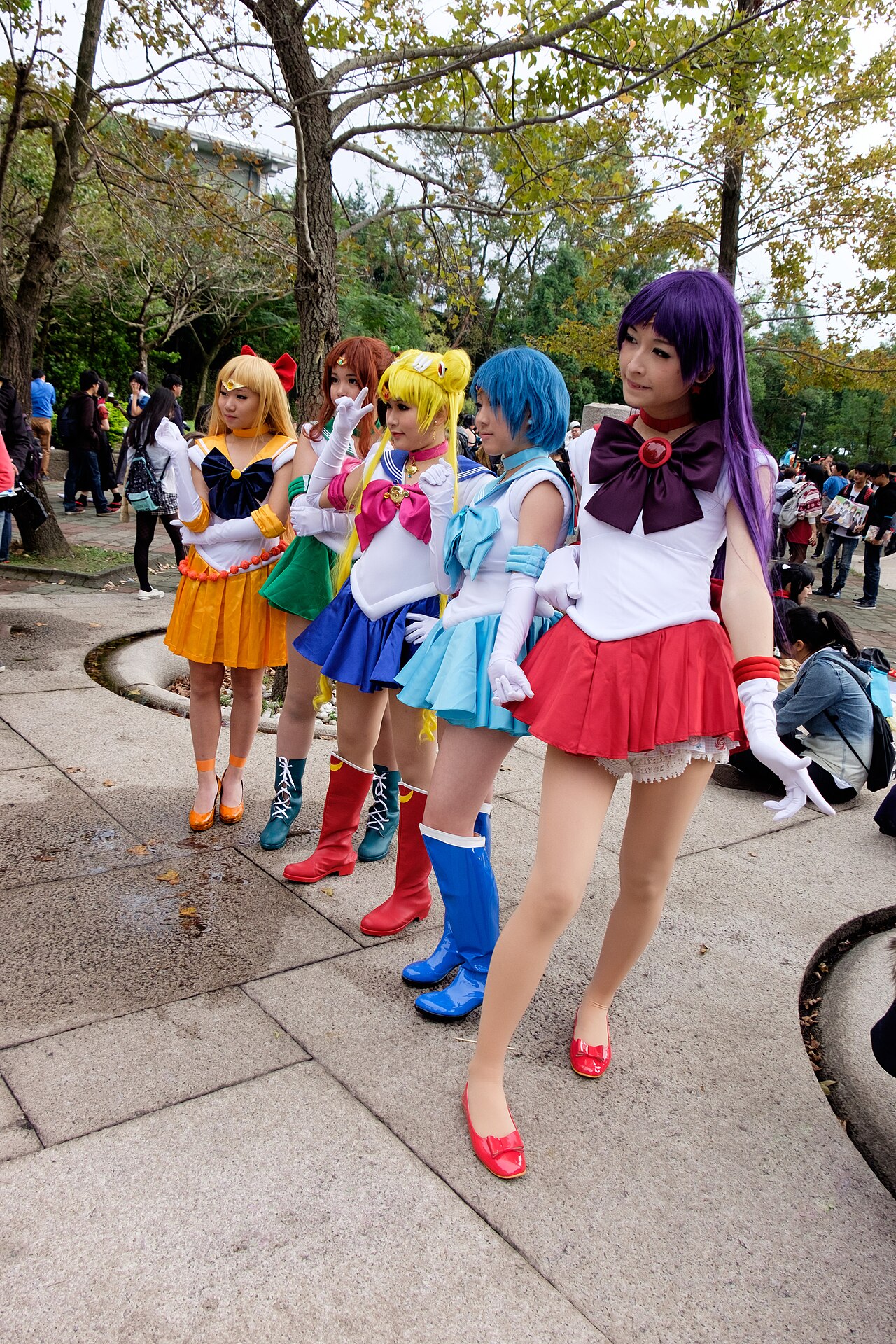
Sailor Moon cosplayers at a fan convention (CWT41, 2015) — a representative image of the franchise's enduring international fandom. Public domain (CC0), via Wikimedia Commons.
Sailor Moon aired across dozens of countries through the 1990s and early 2000s, becoming, alongside Dragon Ball Z and later Pokémon, one of the first anime many Western viewers ever saw on daytime television. The 1995 English dub by DiC Entertainment heavily localized the show for North American broadcast standards: character names were changed (Usagi became "Serena"), on-screen Japanese text was removed, entire episodes were cut, and the romantic relationship between Sailor Uranus and Sailor Neptune was rewritten as a cousin relationship to avoid depicting a same-sex couple. Despite — and in some ways because of — this controversy, the dub introduced a generation of English-speaking fans to anime and manga fandom, seeding conventions, fan translation ("scanlation") communities, and fan fiction culture that helped anime take root as a mainstream interest outside Japan.
Later re-dubs (Viz Media, 2014 onward) restored the original names, dialogue, and the Uranus–Neptune relationship, reflecting how attitudes toward faithful localization shifted over the following two decades.
Sailor Moon Crystal and Ongoing Legacy
To mark the manga's 20th anniversary, Toei produced Sailor Moon Crystal (2014–2016, plus the 2023 Sailor Moon Cosmos films), a new anime adaptation that hews much more closely to Takeuchi's original manga art and pacing than the 1990s series did. It streamed simultaneously worldwide, a distribution model unavailable at the franchise's 1990s debut.
The franchise's 30th anniversary in 2021–2022 brought a touring exhibition on the series' history, a stage-musical retrospective revue (Chronicle, 2022) continuing a tradition of over 30 Sailor Moon musicals ("Sera Myu") staged since 1993, and extensive merchandise collaborations with brands including Sanrio, UNIQLO, and Bandai. A permanent official Sailor Moon store operates in Tokyo, and the franchise remains one of the best-selling manga series of all time, with well over 40 million copies in print worldwide.
Related Terms
Related Dictionary Words
girl (usu. between 7 and 17); young lady
soldier; combatant; warrior
metamorphosis; disguise; transformation; shapeshifting; morphing
magic; witchcraft; sorcery; spell
beautiful girl
love; affection; care
justice; right; righteousness
opponent; rival; adversary
friend; ally; supporter
cat (esp. the domestic cat, Felis catus); feline
sailor suit; middy uniform
magical girl (in anime, manga, etc.); girl with magical powers; young witch