商店街
shoutengaiA traditional Japanese shopping street lined with small, independently-owned shops, often covered by an arcade roof and once the beating heart of neighborhood commerce.
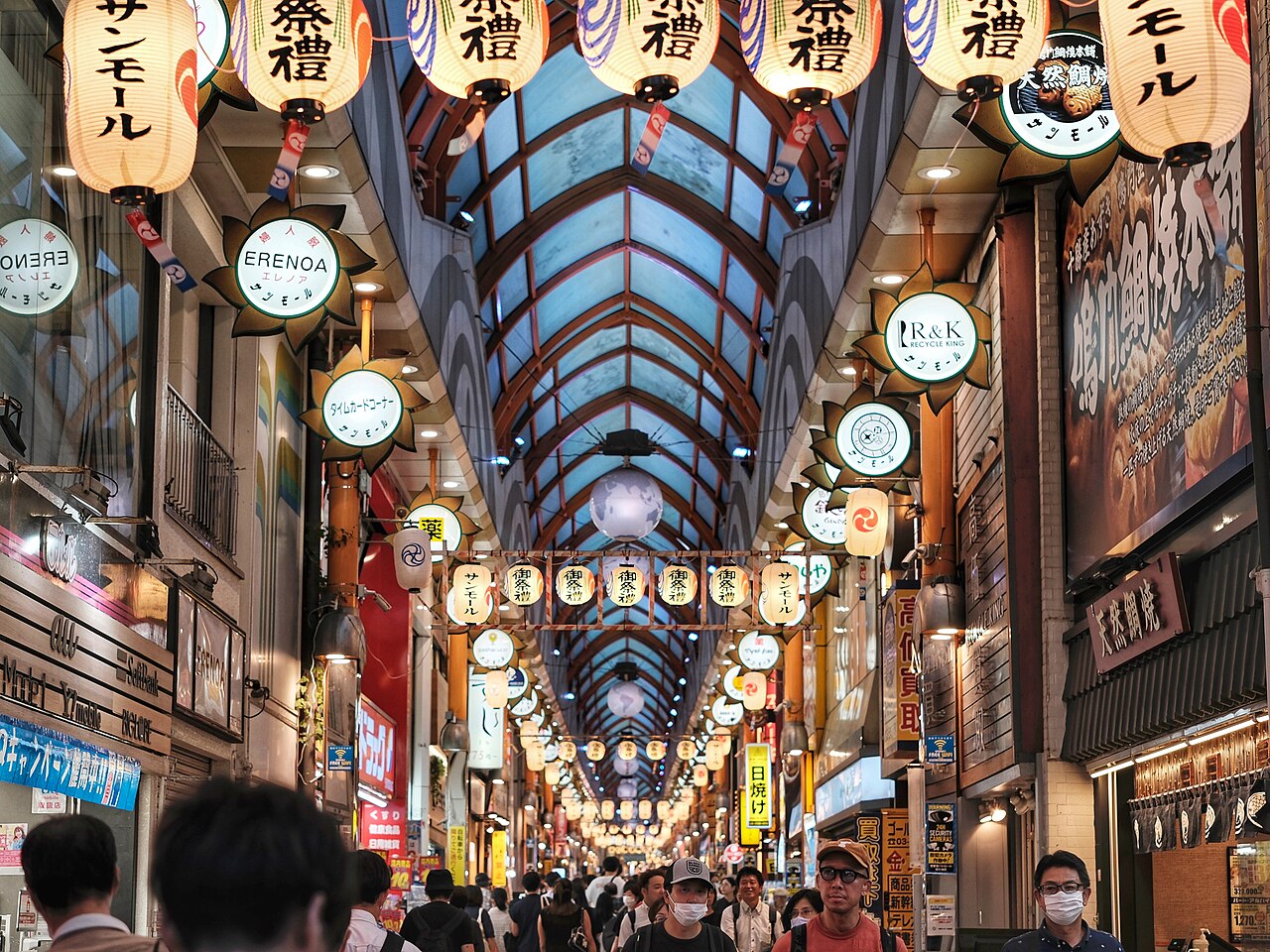
A covered shopping arcade in Nakano, Tokyo — the glass-and-steel roof and continuous run of small shopfronts are the defining look of a shotengai. Photo: Charlie fong, CC BY-SA 4.0, via Wikimedia Commons.
Meaning
商店街 (しょうてんがい, shotengai) literally means "merchant street" — 商店 (shoten, "shop/store") + 街 (gai, "town/street"). It refers to a cluster or strip of independently owned small shops, typically along a single pedestrian street, that together function as a neighborhood's commercial and social center.
The defining physical feature of many shotengai — and the one that makes them instantly recognizable — is the アーケード (ākēdo, "arcade"): a translucent roof spanning the full width of the street, held up by steel trusses over the shopfronts. This turns the street into a covered, weatherproof corridor, so shoppers can browse in the rain or under the summer sun without an umbrella. Not every shotengai is arcaded — some are simply open streets with a shared shopping-district identity and a shopkeepers' association — but the covered version is the archetype most people picture.
What kind of shops make up a shotengai
A shotengai is not one retailer with many departments; it's dozens of separate family-run businesses standing shoulder to shoulder, each specializing in one thing the way corner shops did across Japan before supermarkets and department stores standardized retail. A typical lineup includes:
| Shop type | Japanese |
|---|---|
| Greengrocer | 八百屋 (yaoya) |
| Fishmonger | 魚屋 (sakanaya) |
| Butcher | 肉屋 (nikuya) |
| Tofu shop | 豆腐屋 (tōfuya) |
| Bakery | パン屋 (pan'ya) |
| Prepared-food/deli shop | 惣菜 (sōzai) shop |
| Pub/tavern | 居酒屋 (izakaya) |
| Hardware store | 金物屋 (kanamonoya) |
| Public bathhouse | 銭湯 (sentō) |
Many of these are 個人商店 (kojin shoten, "individually owned shops") that have been run by the same family for generations, with the owner living above or behind the storefront. This is what sets a shotengai apart from a modern shopping mall or a chain-store street: the relationship is personal. The fishmonger knows your name, the greengrocer throws in an extra daikon, and haggling or small talk over the counter is part of the transaction.
Usage
駅前の商店街で夕飯の買い物をする。 Ekimae no shotengai de yūhan no kaimono o suru. "I do my shopping for dinner at the shopping street in front of the station."
このアーケード商店街は昭和レトロな雰囲気が人気です。 Kono ākēdo shotengai wa Shōwa-retoro na fun'iki ga ninki desu. "This covered shopping arcade is popular for its Showa-retro atmosphere."
Japanese distinguishes a shotengai from other retail formats people encounter daily. It's not a デパ地下 (depachika, a department store's upscale basement food hall), not a コンビニ (convenience store) chain, and not a single big-box retailer like ドン・キホーテ, ユニクロ, or ニトリ. A shotengai is a shared street identity — usually organized by a 商店会 (shōtenkai, shopkeepers' association) that puts up the arcade, hangs New Year decorations, and coordinates sales — made up of many small independent proprietors rather than one brand.
Cultural Context
The Showa-era heyday
Shotengai proliferated in the decades after World War II, growing alongside Japan's postwar reconstruction and economic boom. Through the 昭和 era (1926–1989), before supermarkets, convenience stores, and suburban shopping malls became dominant, the neighborhood shotengai was simply where people did their daily shopping — often on foot or bicycle, often more than once a day, since refrigerators were smaller and fresher ingredients were bought as needed. Streets like Osaka's Tenjinbashisuji Shōtengai (天神橋筋商店街), Japan's longest at roughly 2.6 km, and Tokyo's Yanaka Ginza (谷中銀座) grew into dense commercial arteries packed with hundreds of shops.
Decline and "shutter streets"
From the 1990s onward, many shotengai went into steep decline. Large supermarket and department store chains, suburban shopping malls, and eventually online retail drew shoppers away from small individual proprietors who couldn't match their prices or convenience. Japan's aging, shrinking population compounded the problem: elderly shopkeepers retired with no children willing to take over a low-margin family business, and shops simply closed rather than changing hands.
The result is a phenomenon with its own name: シャッター街 (shattā-gai, "shutter street") — a shotengai where a large share of storefronts sit permanently closed behind their metal roll-down shutters, day after day, giving the once-bustling arcade a hollow, half-abandoned feel. Shutter streets are now a familiar sight in smaller cities and regional towns across Japan, and revitalizing them is a recurring topic in local government and urban-policy discussion.
Nostalgia and tourism
Paradoxically, the same qualities that make shotengai commercially outdated — narrow storefronts, hand-painted signs, decades-old fixtures — also make the surviving and thriving ones highly appealing as living time capsules of 昭和レトロ (Shōwa retoro, "Showa retro") atmosphere. Streets like Yanaka Ginza in Tokyo have become popular destinations for both domestic and international tourists, who come to browse old-fashioned candy shops, eat menchi-katsu from a butcher's takeout window, and photograph the retro shop signage — an experience department stores and malls simply cannot offer.
A social hub, not just a market
Beyond commerce, a healthy shotengai functions as a neighborhood's social infrastructure, especially for elderly residents who may not drive. Walking its length to buy groceries doubles as daily exercise and a chance to chat with familiar shopkeepers and neighbors — a form of casual community contact that anonymous supermarket aisles don't replicate. Shotengai associations often organize seasonal events tied to the retail calendar, from summer 祭り (matsuri) with food stalls and lantern decorations to New Year's 福袋 ("lucky bags") sales, when shops bundle discounted surprise merchandise to draw the year's first crowds.
Shotengai vs. other Japanese retail formats
| Format | Structure | Example |
|---|---|---|
| Shotengai | Street of many independent small shops, often arcaded | Yanaka Ginza, Tenjinbashisuji |
| Depachika | Basement food hall inside one department store | Isetan, Mitsukoshi |
| Konbini | Single chain-operated convenience store | 7-Eleven, Lawson |
| Hyakkin | Single chain-operated 100-yen store | Daiso, Seria |
| Shopping mall | Single developer-owned complex of chain tenants | Aeon Mall |
Related Words
Shotengai culture connects closely to other retail concepts covered on this site: the デパ地下 food halls that represent the upscale department-store alternative, and 福袋 lucky bags that shotengai shops sell every New Year alongside big retailers like ドン・キホーテ.
Related Dictionary Words
shopping district; shopping street; downtown
arcade (street)
shop; store; firm
privately run store; one-man business; mom-and-pop store
street where many shops and businesses are closed (e.g. due to an economic slump)
lucky-dip bag; grab bag; mystery package (with a variety of articles possibly worth more than the purchase price)
Shōwa retro; Shōwa era-style; reminiscent of the Shōwa era; Shōwa-nostalgic
greengrocer; fruit and vegetable shop
fish market; fish dealer; fishmonger
tofu seller (maker)
bakery; baker
small dish (served as a part of an ordinary household meal); side dish
izakaya; tavern, bar, etc. that also serves various dishes and snacks
hardware store; hardware dealer; ironmonger
basement of a department store (where foodstuffs are usually sold)
public bath; bathhouse
festival; feast; matsuri