月岡芳年
Tsukioka YoshitoshiWidely regarded as the last great master of ukiyo-e, famed for psychologically intense prints ranging from graphic violence to the serene 'One Hundred Aspects of the Moon' series.
Meaning
Tsukioka Yoshitoshi (月岡芳年, 1839-1892) is widely considered the last great master of 浮世絵 ("pictures of the floating world"), the woodblock print tradition that had flourished across the Edo period. He trained under Utagawa Kuniyoshi and inherited his teacher's restless imagination, but pushed it somewhere Kuniyoshi never fully went: unflinching psychological and physical extremity. Early in his career Yoshitoshi produced some of the most graphically violent prints in the history of the medium; by the end of his life he had refined that same intensity into something quieter and more haunting, culminating in his celebrated final series, One Hundred Aspects of the Moon (月百姿, Tsuki Hyakushi).
Yoshitoshi's career maps almost exactly onto the collapse of the world that made ukiyo-e possible. He began working in the last years of the Tokugawa shogunate and died in 1892, a quarter-century into the Meiji era, as Japan industrialized, adopted photography and lithography, and rapidly westernized. He is frequently described as the artist who closed the book on classical ukiyo-e even as he expanded what the 木版画 (woodblock print) medium could express — a bridge figure between Edo-period tradition and modern Japan, and, in the eyes of many manga and horror scholars, a direct ancestor of the visual language used in Japanese comics and horror art today.
Life and Career
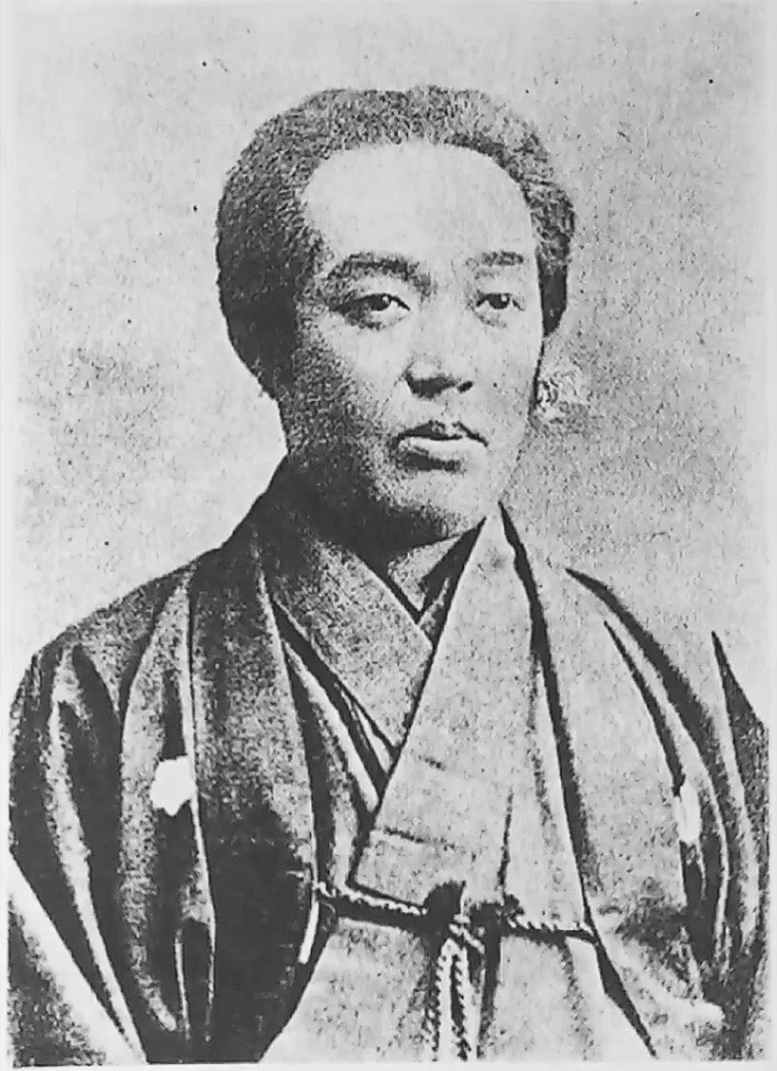
Tsukioka Yoshitoshi, photographed around 1882, reproduced in a 1930s ukiyo-e anthology. Public domain, via Wikimedia Commons.
Born in 1839 in Edo (modern Tokyo), Yoshitoshi entered 浮世絵 training at around age eleven under Utagawa Kuniyoshi, the great warrior- and ghost-print master whose workshop also produced several other influential Meiji-era artists. He made his print debut in 1853 and spent his twenties working through the final chaotic years of the shogunate — a period of civil war, 武士 uprisings, and social upheaval that supplied grim, ready-made subject matter.
In 1866-67, together with fellow Kuniyoshi student Utagawa Yoshiiku, Yoshitoshi produced the series that first made him notorious: Twenty-Eight Famous Murders with Verse (英名二十八衆句, Eimei Nijūhasshūku), each artist contributing fourteen prints. Drawing on kabuki plays and true-crime legend, the series depicted assassinations, torture, and dismemberment in unprecedented graphic detail — blood rendered with a technique using real mica dust and swollen embossed ink for a wet, visceral texture. It scandalized and thrilled audiences in roughly equal measure, and Yoshitoshi followed it with more prints in the same vein, including entries in a One Hundred Ghost Stories series and other supernatural and violent subjects. Later writers grouped this body of work under the label muzan-e (無残絵, "atrocity prints"), and it remains the reason Yoshitoshi is sometimes introduced simply as ukiyo-e's great painter of horror.
The Meiji Restoration of 1868 upended the print trade itself. Photography and Western lithography offered cheaper, faster ways to illustrate news and portraits; the samurai culture that had supplied ukiyo-e with its heroic warrior subjects was formally abolished; and public taste swung toward all things Western. Yoshitoshi struggled through the 1870s, and by 1871-72 he had fallen into severe poverty and depression, compounded by the personal sacrifice of his mistress Okoto, who reportedly sold herself into a brothel to support him. Contemporary accounts describe a full mental and physical collapse around 1872, during which he stopped working entirely.
Yoshitoshi recovered by 1873 and marked the turning point by adopting a new studio name, Taiso (大蘇, "great resurrection"). He rebuilt his career pragmatically, illustrating newspapers such as the Yūbin Hōchi Shinbun with woodblock depictions of current events, and gradually re-established himself as the leading print artist of the day — eventually training his own influential circle of students and winning acclaim through the 1880s for history and legend series markedly more restrained and painterly than his violent early work.
Signature Style and Major Series
Twenty-Eight Famous Murders and the Muzan-e
Yoshitoshi's earliest famous works are defined by extremity: 血 and torn flesh rendered in tactile detail, victims caught mid-scream, compositions that crop in tight on the moment of violence rather than staging it at a theatrical distance. It is unmistakably indebted to Kuniyoshi's dynamic, twisting figures, but Yoshitoshi strips away Kuniyoshi's more heroic framing in favor of something closer to psychological horror — 暴力 not as spectacle but as dread. Historians generally read the series as riding a real contemporary appetite for violent kabuki and grisly news, but it has also outlived that context to become a touchstone for later horror manga artists searching for a homegrown visual precedent to Western horror.
One Hundred Aspects of the Moon
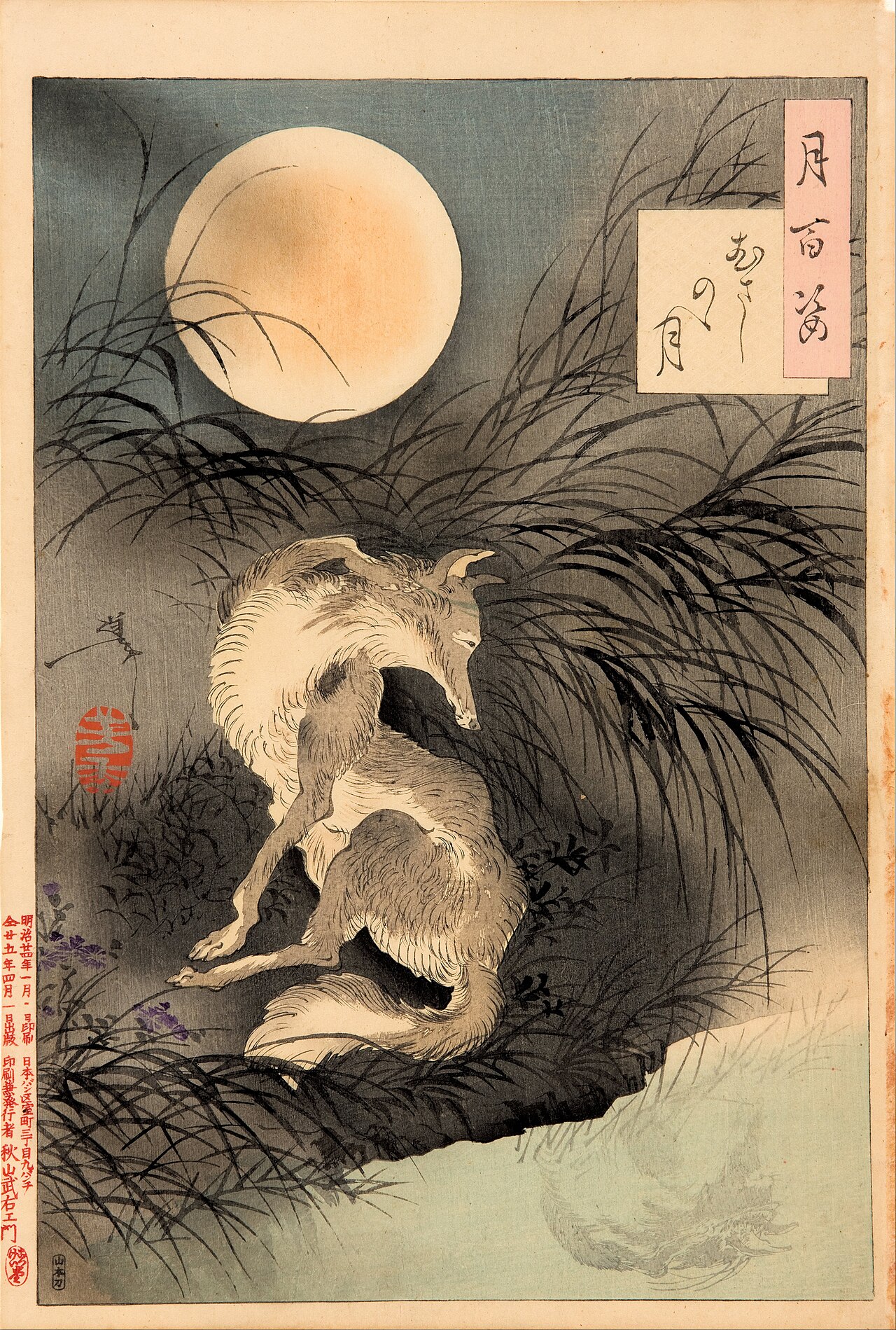
"The Moon on Musashi Plain" (武蔵野の月, Musashino no Tsuki), from One Hundred Aspects of the Moon (1892). Public domain, via Wikimedia Commons.
Yoshitoshi's late masterpiece, begun in 1885 and left unfinished at his death in 1892, is the polar opposite in tone. One Hundred Aspects of the 月 pairs one hundred single-figure prints — historical warriors, court poets, courtesans, folkloric spirits, Chinese legends — with a moon rendered in every mood, from a thin crescent to a blank, glowing disc. Where the muzan-e pursued shock, this series pursues stillness and interiority: figures are caught mid-thought, mid-grief, or mid-vigil, and the moon functions less as scenery than as a psychological mirror for each subject. It is now considered Yoshitoshi's finest achievement and one of the last indisputably great works of classical ukiyo-e, still reproduced constantly in exhibitions, books, and prints today.
History, Legend, and Newspaper Illustration
Between these two poles, Yoshitoshi worked prolifically across historical warrior prints, kabuki actor portraits, beauties, and illustrated news — the Yūbin Hōchi Shinbun work in particular shows him adapting ukiyo-e technique to a modern journalistic function, reporting real contemporary incidents in woodblock form even as 新聞 illustration was beginning its shift toward photography and lithography. Across all of it, contemporaries and later critics single out his handling of facial expression and body language — a command of 心理 (psychology) rendered through posture and gaze that goes well beyond the more decorative figure work typical of earlier ukiyo-e.
Cultural Context and Legacy
Yoshitoshi worked through the single most disruptive stretch in ukiyo-e's history: the end of the 江戸 shogunate, the 明治維新, and the arrival of photography and Western printing technology that would make woodblock illustration commercially obsolete within a generation. His documented breakdown in the early 1870s is often read, retrospectively, as inseparable from that context — a personal crisis that mirrored the collapse of the entire artistic and social world ukiyo-e depended on. That he not only recovered but produced his most celebrated, mature work in the two decades that followed is central to why he is remembered as ukiyo-e's last great master rather than merely its last practitioner: he didn't just outlast the tradition, he pushed it to a genuine artistic peak on the way out.
Yoshitoshi trained a large workshop of 弟子 (students, disciples), several of whom carried woodblock technique and composition into the 20th century as the trade contracted. His broader influence, though, runs directly into modern Japanese visual culture: his willingness to render extreme violence and psychological horror with unflinching, tactile detail is regularly cited by manga historians as a direct forerunner of Japan's horror manga tradition, from Shigeru Mizuki's yōkai illustration to the anatomical dread of artists like Junji Ito. His late, restrained figure studies in One Hundred Aspects of the Moon are held up on the opposite end as a model for expressive economy — proof that a single figure, a gesture, and a mood can carry as much weight as a crowded, violent scene. Museums and collectors treat him today as the essential hinge figure of ukiyo-e: trained in, and clearly loyal to, the Edo tradition of Utagawa Kuniyoshi and the 錦絵 print, yet unmistakably a modern, psychologically probing artist working at the birth of Meiji Japan.
Related Terms
Related Dictionary Words
ukiyo-e; ukiyoe; Edo-period woodblock print
samurai; warrior
ghost; specter; spectre; apparition; phantom
ghost; apparition; phantom; spectre; specter; demon; monster; goblin; yōkai
woodblock print; woodcut; woodprint
nishiki-e; multi-colour woodblock print
actor print; yakusha-e; ukiyo-e print of kabuki actors
Meiji Restoration (1868)
pupil; disciple; adherent; follower; apprentice; young person; teacher's student-helper